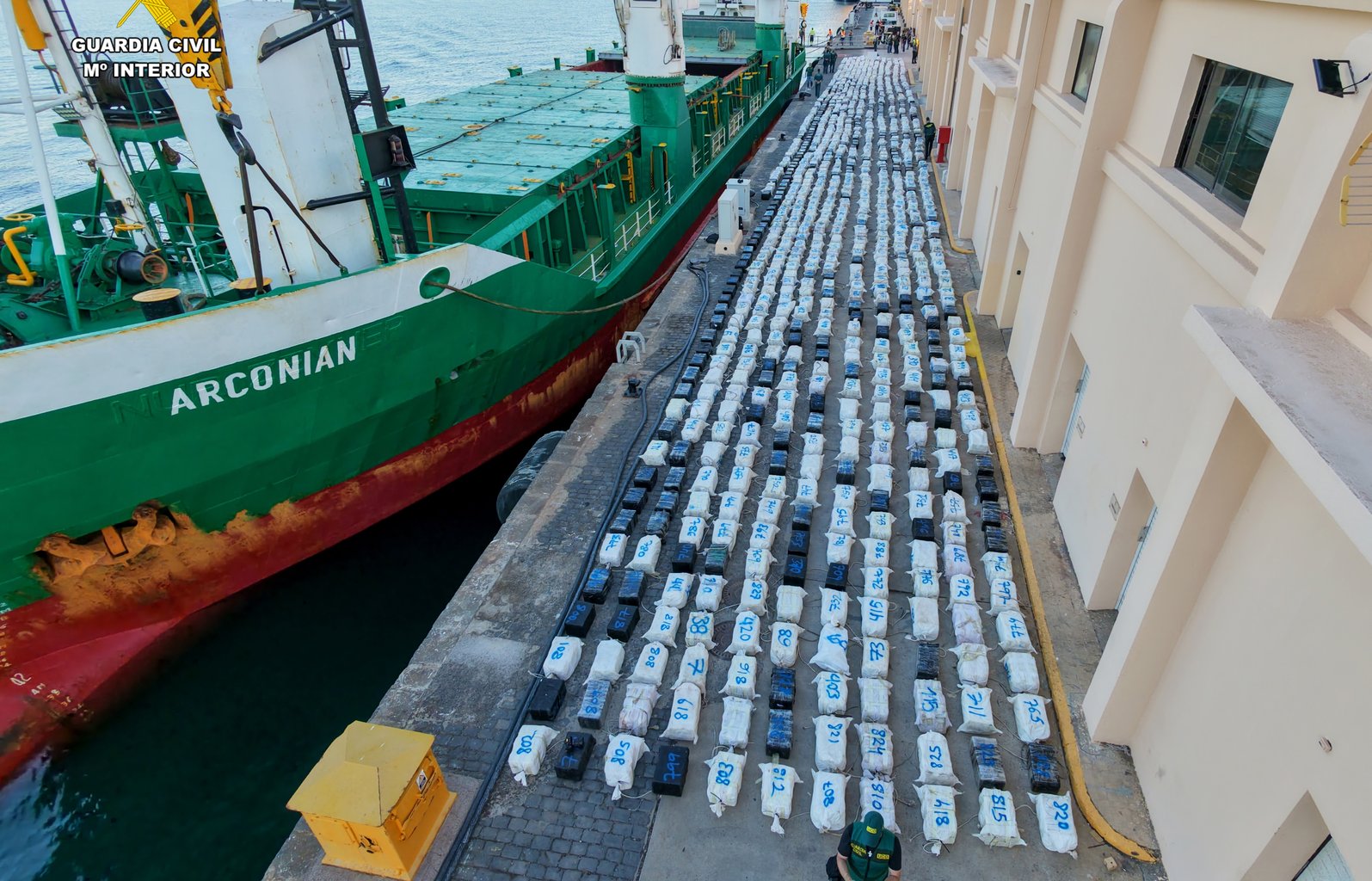
Thirty tonnes of cocaine laid out in eleven and a half rows is roughly the same length as the 91 metre cargo ship that smuggled it to Europe. The largest cocaine bust ever recorded at sea currently sits inside a naval base in Las Palmas de Gran Canaria. Seized from the Arconian cargo vessel off Dakhla in Western Sahara on 1 May, the record-breaking shipment points to the existence of a new ‘super alliance’ of Dutch and Turkish cocaine traffickers whose methods are reshaping Atlantic smuggling routes and cocaine imports into Europe through the Mediterranean.
Spain’s Guardia Civil stopped the Arconian as it approached the Canary Islands from Freetown, Sierra Leone, where the ship is owned. They arrested the entire 23-person crew, 18 Filipinos and five Dutch nationals, one of whom was of Surinamese origin. They were reportedly heavily armed. The plan had been to dump floating bundles of cocaine into the waters beside the Spanish islands for collection by “narcolanchas”—speed and fishing boats used by the narcos to make a quick getaway.
The size of the shipment and the Arconian’s stated destination in Benghazi suggest that the operation may have continued on to further drop-off points in the Mediterranean, to the waters around Sicily and Greece, which have proved popular in the past.
The Black Sea, IrpiMedia and RTL Nieuws have discovered that the vessel at the centre of the world’s largest maritime drug seizure belongs to a fleet linked to rising Turkish-Dutch underworld figure Çetin Gören and Dutch fugitive Joseph Johannes Leijdekkers, known as “Bolle Jos” (“Fat Jos”).
Last year, we reported on the growing role of other Turkish mafia figures in Mediterranean cocaine trafficking, revealing how organised crime has pioneered new ways to transport unprecedented quantities of cocaine from the Caribbean to Europe in cargo vessels.
But our latest findings indicate the existence of an evolved alliance of criminal gangs of Dutch and Turkish origin, who are refining the drop-off technique into a consolidated, multi-drop courier service at sea.
The Drop-Off Method on Drugs
The massive shipment of the Arconian is not an isolated case. The Arconian appears to be part of a fleet of vessels connected to Mediterranean drug smuggling, which have been transporting increasingly large quantities of cocaine.
A pattern emerges. Narcos buy ageing cargo vessels for one or two million euros, which are then directed to the Caribbean, where maritime enforcement is looser. The ships are loaded with huge quantities of Colombian cocaine from transit points in Suriname, Venezuela, or Trinidad and Tobago, and then sail towards West Africa. Once there, the cargo is stored temporarily, often with the complicity of corrupt officials, before being transferred onto other vessels.
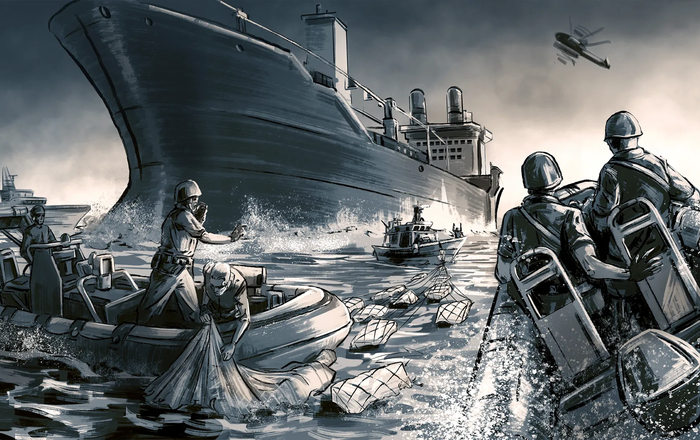
These vessels, like the Arconian, then head to Europe. While still in international waters, beyond the reach of national police agencies, the crew dumps floating bales of cocaine overboard. Local organised crime groups from Spain, Italy, and the Balkans collect the cargo in fast-moving fishing vessels and bring it to shore, where it is quickly distributed throughout Europe.
The ships often depart for Benghazi, the Libyan port under the control of General Khalifa Haftar. Sources said that Haftar may be permitting these vessels to use the eastern part of the country, where he is de facto ruler, to refuel safely in exchange for a fee.
The “drop-off” method emerged around 2020, peaked in 2023, and then appeared to fall out of favour. Since the first half of 2026, it has returned with greater intensity, as ever larger shipments have been intercepted en route to Europe.
The Plutus cargo ship, seized off the coast of Sicily in July 2023, carried around 5 tonnes of cocaine. The United S, intercepted in January this year, was found with 10 tonnes. The Arconian had a load of over 30 tonnes.
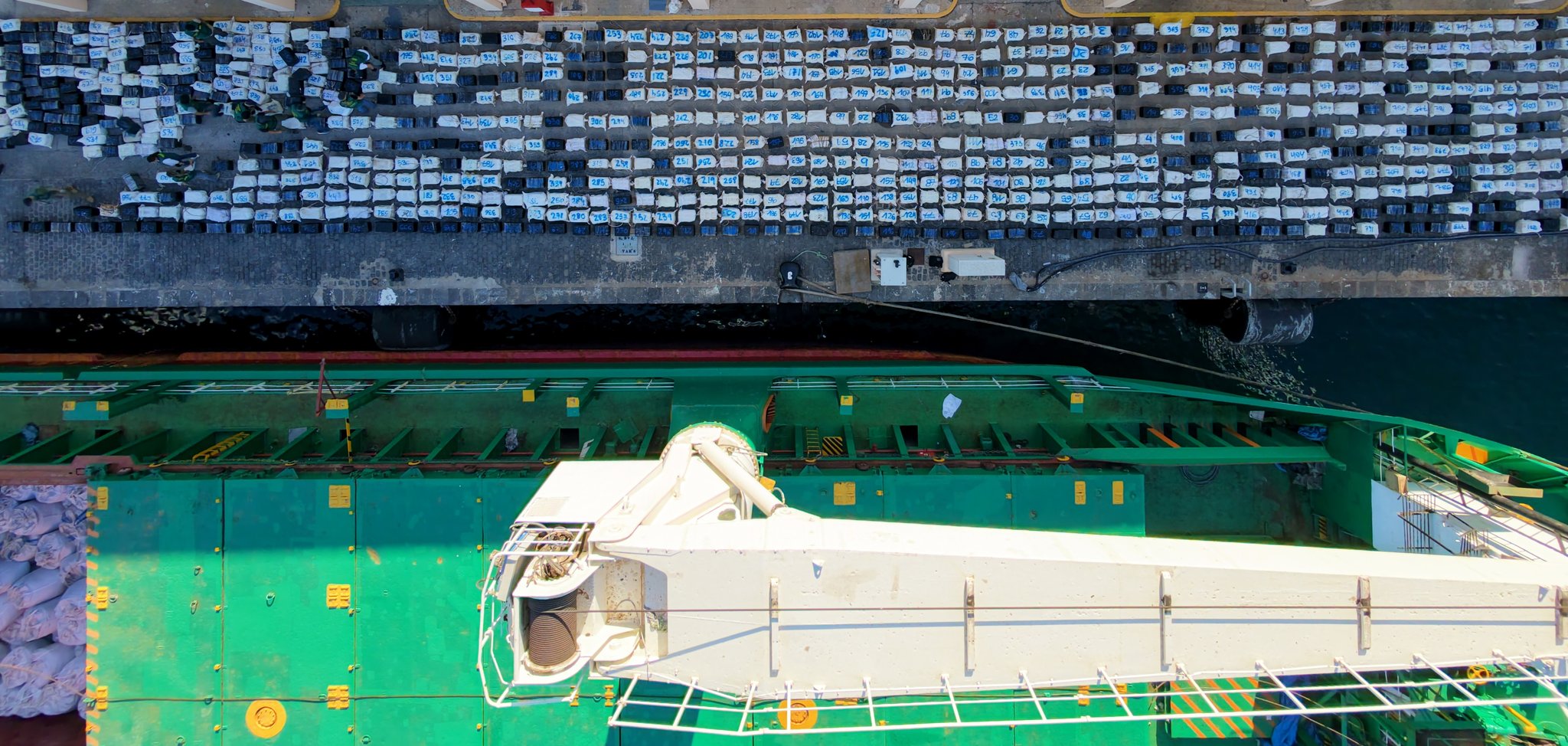
What is new is the scale. Narcos have adapted and implemented small but significant changes in how cocaine moves from South America to the Mediterranean. Although European authorities have already intercepted tens of tonnes of cocaine along routes feeding the Mediterranean this year, the Arconian bust suggests the traffickers retained confidence in the scheme. They would be unlikely to risk transporting 30 tonnes otherwise.
The sustained fall in wholesale cocaine prices is pushing traffickers to move ever larger loads, a trend that in turn fuels further price declines. Yet even at today’s lower prices, a 30-tonne shipment costs tens of millions of dollars, a cost far higher than any single group should want to put up by themselves and then place on a single ship bound for Europe.
This evidence all points to the emergence of a new narco ‘super alliance’ of multiple mafia buyers, with consolidated shipments, and shared logistics, managed by Turkish and Dutch trafficking networks.
The model appears to rely on transporting smaller loads in stages to hubs just outside Europe, having avoided crossing the entire Atlantic with a massive quantity of cocaine. Once there, traffickers can then assemble them into a single haul under safer conditions. Sierra Leone now appears among these hubs, joining Guinea-Bissau and the Ivory Coast, long regarded as safe havens for the trafficking activities of organised crime groups like the Italian ‘Ndrangheta.
Sierra Leone’s role as a staging hub may be no accident. One of the country’s newest residents is fugitive Joseph Johannes Leijdekkers, the Netherlands’ most wanted drug trafficker.
Following the Fleet
The Black Sea, IrpiMedia, and RTL Nieuws examined the individuals and companies around the Arconian and the other recent cocaine busts at sea, uncovering suspected links to Leijdekkers, known as Bolle Jos (“Fat Jos”) and another convicted trafficker, Çetin Gören.
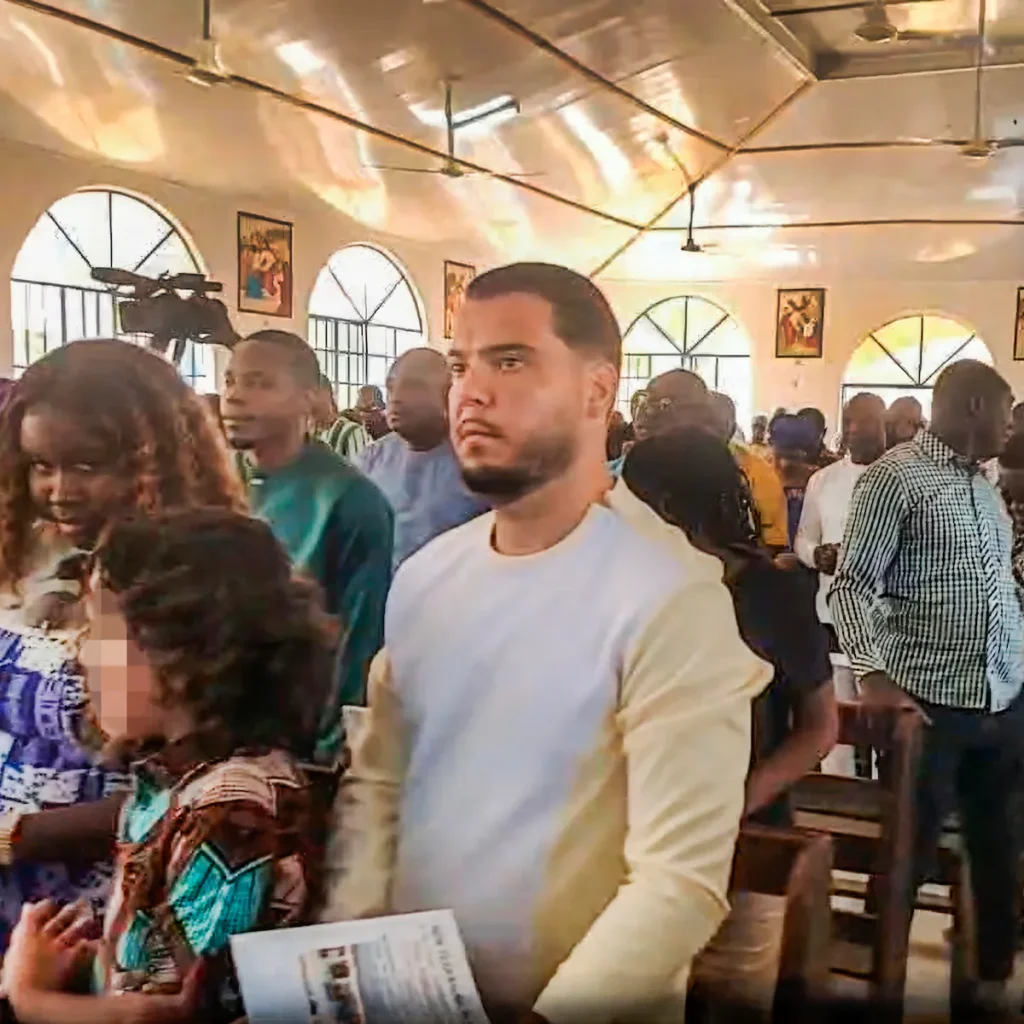
Leijdekkers is at the centre of this industrial-scale growth in drug trafficking, according to several major law enforcement agencies. Convicted in absentia in 2024 for trafficking and murder, Leijdekkers, who has long been sought by Interpol, fled Turkey for Dubai in 2024 before moving on to Sierra Leone, where he appears to have established close ties to the government that allow him to operate freely.
According to Narcodiario and other media, Leijdekkers uses the name Omar Sheriff, is reportedly in a relationship with the daughter of President Julius Maada Wonie Bio, and recently fathered a child with her.
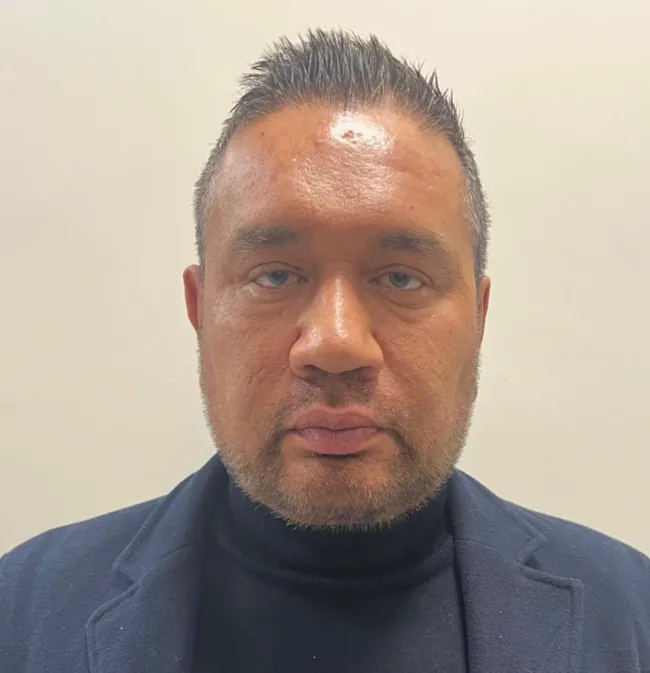
Leijdekkers in Sierra Leone
Çetin Gören
Çetin Gören is a 56-year-old Turkish-Dutch convicted drug trafficker who has been investigated by multiple countries. He is not yet regarded as a heavyweight in Turkey, but Dutch police sources told us that he has developed connections and influence enabling him to organise huge cocaine transports using the drop-off method.
Following his arrest in Istanbul, police retrieved a video from Gören's phone of him telling a bedtime story to his newborn daughter. “Our ships are heading towards Colombia. When they arrive in Colombia, the cartels will take the packages and put them inside the ships. We will deliver them by sea. Fish will come and take the packages and bring them ashore. Engin and Metin will take them and distribute them to the houses, then your father will get his money.”
The connection among the cargo vessels, among them the Arconian, is a German-based company, Tunaryan Schifffahrts GmbH & Co KG, registered in Flensburg, a small maritime city on the border with Denmark.
Tunaryan’s principal is Captain H. A., a German-born businessman of Turkish origin with several companies in Flensburg. Family and corporate records show strong ties to Gaziantep, where he is also CEO of the maritime management firm, Nisa Denizcilik, which provided technical services for the vessels in the fleet.
Public records show Tunaryan acted as commercial manager of four cargo vessels, the Arconian, White Eagle, White Labeille and Azra C. These ships were owned by opaque companies in the Marshall Islands and Antigua & Barbuda. Captain H. A. told us by email that he was the legal owner of these offshore companies and the ships, but had sold them to new owners before they ever became linked to cocaine-smuggling cases.
There is no evidence that Tunaryan or Captain H. A. participated in drug trafficking or knew that the ships were being purchased for use in illegal smuggling. He told us that the sales were conducted “via international[ly] recognized brokers, after our lawyers’ [know your customers] process. (some of them even reaching close to 4 years of a time).” He said he does not know who the new owners are.
Nevertheless, three of the ships have been directly connected to drug busts, and a fourth has been implicated in trafficking. In February 2026, two months before the Arconian departed for the Mediterranean with its cargo, it was purchased by Serenity Shipping SL Ltd, listed at a Freetown address. Another is White Eagle, a 91-metre cargo ship, also registered to a company in Sierra Leone, Imperial Shipping SL Ltd. Mohammed Mansaray, an opposition leader who fled Sierra Leone, told Dutch newspaper AD that Leijdekkers also owns White Eagle, an assertion supported by police sources we spoke with.
Four Ships, One Pattern
The White Eagle has been laid up for more than a year in Nador port in Morocco after suffering a technical problem without access to repair facilities. It had been travelling from Sierra Leone with a mostly Filipino crew and turned off its transponder as it neared Moroccan waters.
A police source corroborated. "Because the ship belongs to Bolle Jos, we followed it. The suspicion was that it was being used for drug smuggling," they said.
Some reports state that the Moroccan navy forcibly escorted the ship to shore. News reports at the time said that the White Eagle was suspected of being used for drug trafficking. Moroccan authorities have not publicly said whether the vessel was searched.
Another vessel from Tunaryan’s former fleet, the Azra C, may provide a link between the alleged operations of Leijdekkers and Gören. The cargo ship, then named Breadbox Marlin, was managed by Nisa Denizcilik and another offshore company owned by Captain H. A., EFE Shipping Co Ltd.
In January this year, when Spanish authorities seized 10 tonnes of cocaine from the United S, Turkish authorities arrested ten people, including Gören, on suspicion of international drug trafficking and establishing a criminal organisation. According to Turkish police records, suspects questioned in the case said the United S had been exchanged for the Azra C, but did not say why. Turkish police believe that United S suffered an engine failure, and Azra C was brought in to replace it for the shipment, which they say links Gören to both vessels. Gören denies ownership of the ships and any role in the trafficking scheme.

United S was seized in the Canary Islands
The connection made between the two ships prompted Turkish police to detain the Azra C, which was in Istanbul. It remained there for months, with a small crew stuck on board. The remaining crew were brought ashore only yesterday after months of seeking help from the authorities.
The United S reportedly loaded its cocaine off the coast of Suriname —though other sources put the loading point in Brazil. Tracking data shows it lingering off the Brazilian coast for several days before the captain turned off its AIS system, and it disappeared. The vessel reemerged around Belém seven days later. It later set off towards West Africa and soon switched off its AIS again. Gören’s sister, Belgin Gören, is married to Suriname’s former honorary consul in Amsterdam.
The United S is known to IrpiMedia, that in 2016 reported how the ship, then called Moon Light, was stopped with 18 tonnes of hashish and later found to be among an ageing fleet of vessels used by Syrian drug traffickers to smuggle hashish into Europe. The network was linked to the Assad regime. More than a decade later, the same vessel appears to have found a new life moving cocaine.
Another previously Tunaryan-managed vessel, the White Labeille, was intercepted in 2019 in Cape Verde with 9.5 tonnes of cocaine on board. Police now believe that Leijdekkers and Çetin Gören are in business together. A source close to the criminal underworld also told us, “Bolle Jos and Çetin Gören were partners in the earlier drug shipment of 10,000 kilos to Spain.”
Fat Jos and the $500 Million Man
Çetin Gören is a well-known criminal in the Netherlands, with a record dating back to 1999. Since then he has been investigated, charged, or convicted in Brazil, Peru, Italy, Turkey, and Belgium. He was the subject of two investigations in Brazil and was eventually convicted there of transnational drug trafficking in 2010. He was granted temporary release but fled the country. In 2014, he was linked to a shipment of eight tonnes of cocaine smuggled into the Port of Antwerp, earning himself the nickname “the $500-million man.” In 2016, he was sentenced to 12 years’ imprisonment in the Netherlands but again escaped his sentence after cutting off his electronic ankle monitor and absconding to Turkey.
Later in Turkey, he was put on trial following his arrest in Operasyon Bataklık in 2020, the country’s “largest drug trafficking investigation.” Gören was charged with over 60 counts, including founding an armed criminal organisation, and faced decades in prison. He was subsequently acquitted over lack of evidence.
Also arrested during Bataklık was Mehmet Murat Buldanlıoğlu, who was wanted in France for trafficking €75 million worth of cocaine in a separate case. After his arrest in January, Buldanlıoğlu admitted to establishing Capo Maritime Co., SA., in Honduras to be used in the United S and Azra C exchange. When questioned about this by police, Gören denied directing anyone to open companies or any United S involvement.
Gören’s lawyer told us that his client does “not accept any of the accusations” against him, but would need more time to address each of our questions in detail.
Turkish participation in cocaine drop-offs in the Mediterranean has been on the rise in recent years. Following the death of Urfi Çetinkaya, known as Turkey’s Escobar, in 2024, there appears to be new figures building on his legacy, among them Y.D., a former Çetinkaya lieutenant who remains a fugitive.
No concrete evidence links Gören’s clan or Çetinkaya’s successors directly to Leijdekkers. But the networks overlap in other ways beyond the vessels and the Tunaryan connection. The Turkish indictment that led to the conviction of Çetinkaya and members of his gang said the group was in contact with another prominent Turkish trafficker named Abdullah Alp Üstün, alias “Don Vito”. Üstün’s and Leijdekkers’s wives are sisters, making the two men brothers-in-law. Üstün has reportedly spent time with him in Sierra Leone. Last year, he was extradited back to Turkey from the UAE to begin a prison sentence.
Dutch authorities issued a Red Notice for Leijdekkers’s brother, Wilhelmus Adrianus Leijdekkers, after the Arconian was seized. Turkish police later detained him in Pendik, İstanbul. In May, Wilhelmus was extradited from Turkey to the Netherlands, where prosecutors say he is suspected of laundering cocaine profits.
Jos Leijdekkers's lawyer, Guy Weski, did not respond to questions from RTL Nieuws, but he reiterated that the allegations against Leijdekkers were based only on rumours. "It is therefore beginning to look very much like every criminal offense that takes place on the African continent or in its waters is being associated with my client," he said.
The Netherlands has filed numerous extradition requests with the Sierra Leonean government and all have gone unanswered.