Taşpınar is a small village located within Karacabey, a region outside Bursa renowned for its onions. For decades, it was a thriving farming community, blessed with fertile soils that yielded wheat and barley, and were home to vibrant orchards. Sitting in a fruitful corridor between the Marmara Sea and Lake Uluabat, a Ramsar-protected wetland, the area was alive with a diverse array of bird species. Villagers ploughed the fields, cows grazed on its meadows, and the coffeehouse bustled with the young and the old. The tradition of imece – communal solidarity and collective work – endured.
Today, Taşpınar is empty. Much of its surrounding fields are barren, its houses abandoned, its community fractured by the bleak expanse of concrete. The farmland that once sustained the local way of life has been swallowed up by Teknosab, “Turkey’s first new generation, local, innovative and green organised industrial zone.”
When we visited Taşpınar in August this year, we spoke with four villagers, three of them farmers. Mustafa Cingöz, in his sixties, had worked a large piece of land he owned for decades, growing wheat, barley, and corn, and farming livestock. Today, he tills a few of the last surviving fields, which he rents from those who have left.
In the village coffeehouse, he pointed to the empty tables and chairs. “This place used to be full,” he said. “There used to be young and old, full of life. Now we’re four people sitting here. It messes with you psychologically. No one is left.”
President Erdoğan attended Teknosab ceremonies twice, the first in 2023 to hail the opening of the first –and only– factory. He visited again in 2024 to launch 15 more companies, some of which are still not operational today. This marvel of Turkey’s modern ambition still stands largely empty. We counted around ten factories in operation – less than 10% of the site’s capacity – just as many locals and scientists predicted a decade ago.
Teknosab is a striking testament to Turkey’s determination to expand industry, even at the expense of its most productive soils, nature land, and the villages that depend on them.
In recent years, Turkey has added more than 43 new organised industrial zones and expanded around 60 others. Each time, it consumes another piece of nature or farmland, a pattern of destruction visible across the country.
The findings are part of Green to Grey, a new cross-border investigation by The Black Sea and initiated by Arena for Journalism in Europe and the Norwegian Broadcasting Corporation, NRK. In total, 41 journalists and scientists from 11 countries collaborated with the Norwegian Institute for Nature Research, Nina, to refine its novel methodology for measuring nature loss. Using satellite imagery, artificial intelligence, and on-the-ground reporting, the investigation reveals a widespread and accelerating disappearance of Europe’s natural and agricultural land. Nina now intends to take the project global, through a crowdsourced citizen science initiative.
Green to Grey found that 30 EEA countries, plus the UK, Ukraine, and the Balkans, lost approximately 9,000 km² of nature and cropland between 2018 and 2024—an area roughly the size of Cyprus. (Liechtenstein, Luxembourg, Cyprus, and Malta were excluded for practical reasons.)
Each year, construction replaced 900 km² of nature and 600 km² of farmland, equivalent to 30 km² destroyed every week, or 600 football pitches every single day.
Turkey was by far the biggest offender among the countries analysed, losing more than 1,860 km² of nature and agricultural land and more than any other in Europe. The land erased between 2018 and 2024 would cover an area 150% bigger than Rome, 17 times larger than Paris, and twice the size of Berlin.
Although it accounts for only 12% of the total land area examined, it was responsible for nearly 21% of the nature lost. It amounts to 0.83 km² erased every day.
“A VILLAGE IN NAME ONLY”


Taşpınar, Teknosab behind
"Teknosab is becoming a technology center. Thousands of jobs, high technology university, eco-friendly next-generation industrial zone, with billions of dollars export goal."
The path to Teknosab began over a decade ago. In 2012, the Bursa City Council held several meetings with scientists, unions, trade associations, industry leaders, and other stakeholders to discuss the city’s future and develop an environmental plan to propose to the government. The city’s industrial areas were part of the conversations.
“They took the opinions of around 160 scientists and over two thousand people,” said Ertuğrul Aksoy, a lecturer at Uludağ University’s Faculty of Agriculture, who also serves as the president of the Bursa City Council. “At that time, there was a 40% vacancy in industrial zones. It was decided that there was no need for a new [one].”
But just three years later, investors pressed ahead with a proposal for a sprawling industrial zone west of Bursa, on Taşpınar’s land. The reasons that make croplands like Taşpınar valuable are the same reasons industry covets them: they’re flat, fertile, and close to water.
“Farmlands generally have a slope level close to zero,” said Dr Esra Yazıcı Gökmen, Urban and Regional Planning Expert at Tema Foundation, Turkey’s prominent environmental rights NGO. "This makes agricultural land more attractive because it reduces infrastructure and construction costs. Moreover, proximity to water resources in these areas is also critical for industrial activities.”
For these reasons, farmland is almost always irreplaceable. After the proposal became public, the Union of Chambers of Turkish Engineers and Architects (TMMOB), the environmental association Doğader, and the Chamber of Agricultural Engineers filed a lawsuit against it.
“City planners, survey engineers, and agricultural engineers from Çukurova University and other universities came and carried out on-site examinations,” Aksoy said. “I had already created the capability soil class maps of that area, and the vast majority was second and third-class agricultural land.”
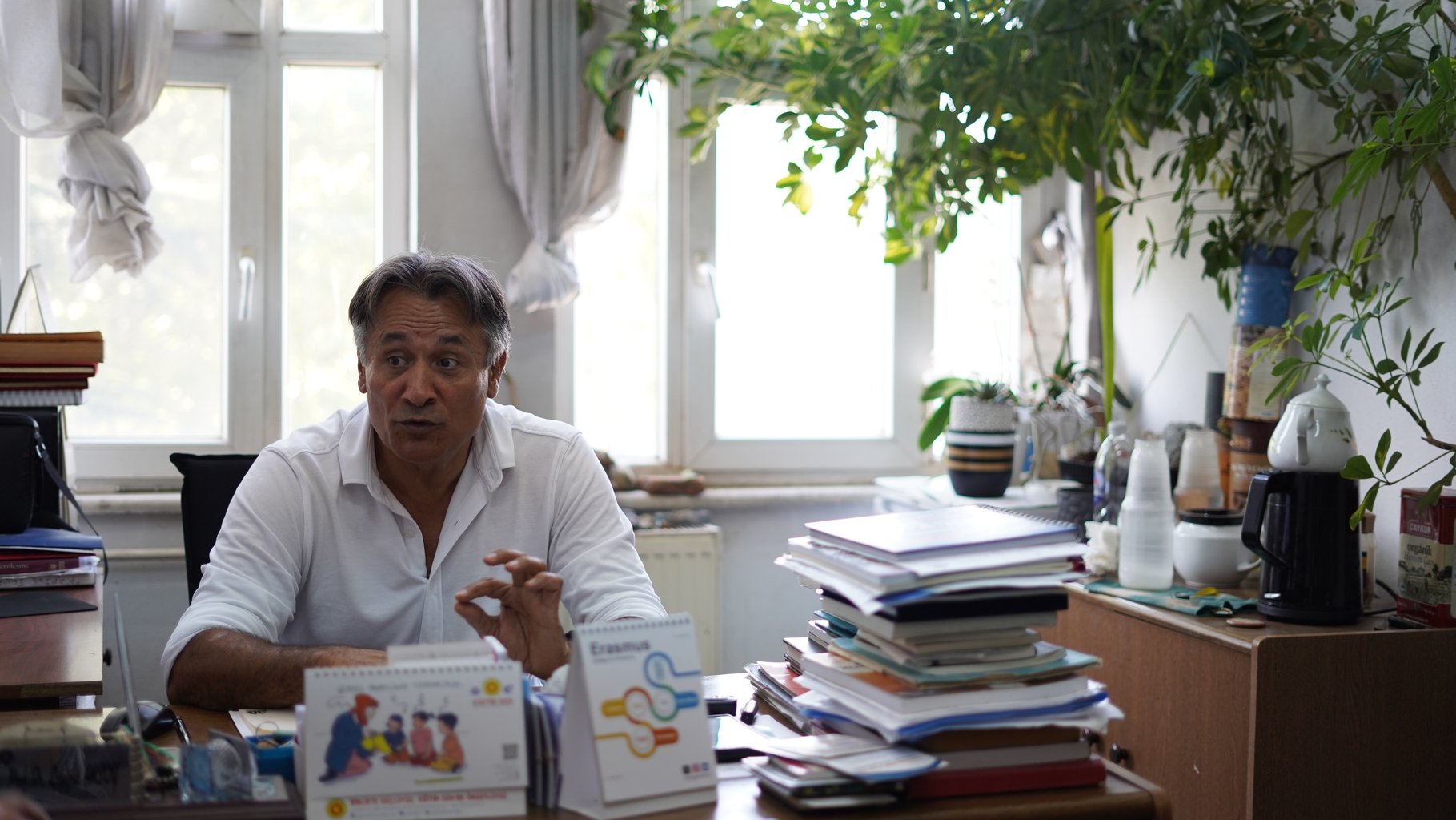
Prof. Ertuğrul Aksoy
During the court process, TMMOB presented conclusions that matched Aksoy’s. Taşpınar soil was highly productive for agriculture, it said, warning that a conversion to industrial use would not only destroy a vital resource but invite land speculation and drive up prices. They raised the prospect that the impact would spread to nearby villages and that the project would ultimately need to draw water from the Çınarcık Dam, which supplies water to Lake Uluabat. These concerns would prove to be valid.
The court at the time felt differently, that the project had an “overriding public interest.” It is a decision that likely further opens the door to similar projects, argued Eylem Tuncaelli, of Tema. “If you place the public interest on the side of the company, if ‘public interest’ becomes ‘corporate interest’ then yes, you lose your most important natural assets,” she said. “We end up talking about land degradation deepening day by day.”
In 2015, the expropriations began. Officials assured some of the villagers they would receive new land in compensation, but when farmers like Mustafa Cingöz went to claim what they’d been promised, they were told no plots were available.
Upon realising he would soon be landless, Cingöz took the issue to court. After a four-year legal battle, the judgment went against him. “Everything was always in [Teknosab’s] favour,” he said. “I never came across a judge who sided with us. We followed other, similar cases, and the villagers never won.”
He lost 2.1 hectares.
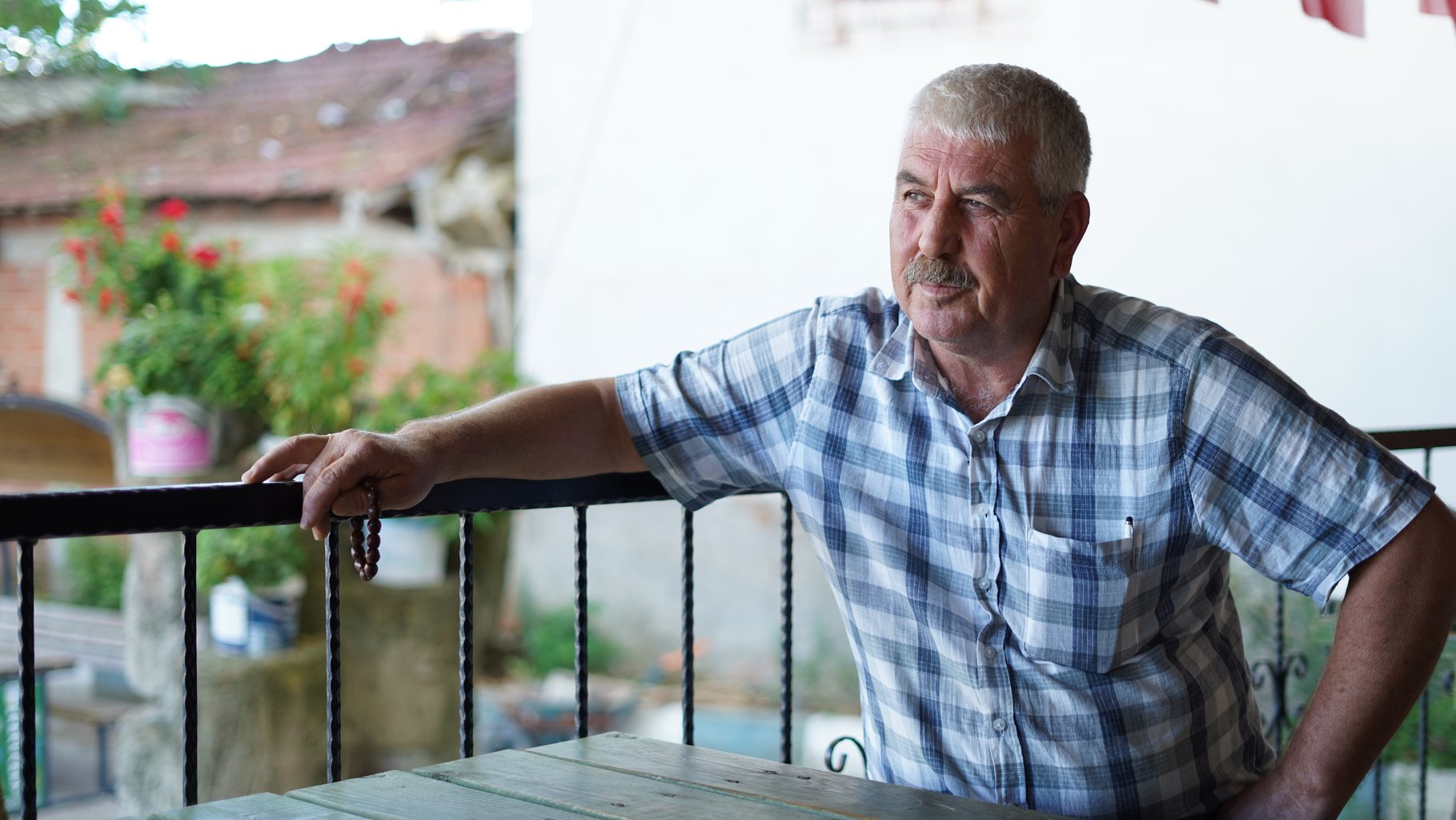
Mustafa Cingöz in the village coffeehouse
On its YouTube channel, Teknosab uploaded an interview with Halil Ersan Özsoy, the CEO of Polyteks, a textile company that opened a factory in Taşpınar. “Organised industrial zones should be established on lands unsuitable for agriculture, that is, non-agricultural lands,” he said. “That should be Bursa’s goal from now on” — seemingly ignoring that Teknosab was built on high-quality, fertile agricultural land.
As part of the same video promo series, Beyçelik Gestamp CEO, Faik Çelik, described the speed at which the takeovers took place. “Within 4–5 months, the expropriations were completed,” he said. “The lands were purchased with the governor’s support, and the plots were allocated.”
Why had the locals given up their land in the first place? Villagers told us of “persuasion rooms,” meetings that took place in a space above the coffeehouse, where officials attempted to appeal to their sense of patriotism by claiming that the Turkish state would build the factories. They spoke the language of duty, local Salih Meşhur said. “They told us the state would build all [the factories], that the private sector would not be involved.” Like his neighbour Cingöz, Meşhur gave up his land and now rents a few small fields.
The Bursa Chamber of Commerce and Industry chairman, İbrahim Burkay, pitched Teknosab as a way to lure foreign capital to Bursa: “three hours of flight distance to the major global market,” the promotional ad declared. All of the firms are Turkish, though French Valeo will begin production soon, and German-Turkish Rudolf-Duraner is completing its environmental assessment.
A decade on, locals’ predictions that the site was unneeded proved correct. Most parcels stand empty – we estimate around 90%. Far from an “innovative and green” revolution, the companies that operate there produce chemicals, textiles, and steel, making Teknosab essentially indistinguishable from Turkey’s other 400-plus industrial zones.
The original Teknosab plan included 274 hectares inside the adjacent Nilüfer municipality. The district fiercely objected to the proposals and successfully blocked them. “The borders of Nilüfer Municipality were excluded,” said Aksoy. “If the Karacabey Municipality had resisted, this project might not have happened.” Instead, the mayor had supported the plans.
Now the damage to Taşpınar is irreversible.


The second phase of Teknosab, with only a couple of factories currently under construction, the rest remains empty.
The Bandırma–Bursa–Osmaneli high-speed railway rises over the villagers’ fields.
THE RIPPLES
The extent of Teknosab’s impact on Lake Uluabat’s vital water supply is also uncertain – and a growing concern. Under an agreement signed with the State Hydraulic Works (DSİ), Teknosab will be granted access to 18.5 million cubic metres of water per year – enough to fill 7,400 Olympic-sized pools – from Çınarcık Dam, which is essential for maintaining Uluabat.
“Transferring fresh water from the Çınarcık Dam to Uluabat is extremely important for the lake’s ecological life,” said Serdar Atilla Erdem, Chairman of the Bursa Branch of the Chamber of Civil Engineers, calling on authorities to reconsider the decision.
Uluabat, a so-called “living lake,” has been a Ramsar site since 1998, an international convention that bestows protected status on important wetland areas, and is one of just a few in Turkey. Its health depends on freshwater inflows, which Teknosab’s presence now threatens.

A small fishing boat in Eskikaraağaç Village, on Lake Uluabat

Storks on the shores of the lake

A Glossy ibis

"Welcome to the European Stork Lake"

An informational sign showing the Uluabat Lake Ramsar Wetland Conservation Area.

Bird photographs taken by wildlife photographer Alper Tüydeş at Lake Uluabat now adorn the village walls.


Teknosab is not the only OSB in the area. Just five minutes away is the Textile OSB, launched in 2013. It has remained empty ever since. Before Teknosab was built, TMMOB calculated that 30–40% of Bursa’s industrial zones were vacant. Many remain so today. Even so, a recent plan for Bursa, Eskişehir, and Bilecik, published last December, proposed the creation of new OSBs in Kestel and Yenişehir, in the east. Among the reasons cited were “current OSB occupancy rates and sectoral concentrations.”
Teknosab is giving birth to even more projects and land take. A logistics park, the Bandırma–Bursa–Osmaneli high-speed railway, new highways, housing complexes. The promise of a new Marmara port, “15 km from Teknosab,” has faded in recent videos, replaced by the improvements to the already existing Bandırma Port.
Teknosab's overseers are a melting pot of local officials, figures from the Bursa Chamber of Commerce and Industry, and company representatives — who are sometimes the same people. İbrahim Burkay, for example, is president of BTSO, sits on the Teknosab board and manages Teknosab Logistics Park, a private company.
Critics argue that these structures – which are common and legal in Turkey’s OSBs – blur the line between public responsibility and private interests because they allow the same network of individuals to oversee industrial zones from which they also profit.
Turkish news outlet Gazete Duvar reported accusations that the handing over of the Teknosab Logistics Centre contract to Bursa Chamber of Commerce and Industry members and Teknosab without a tender process amounted to “abuse of office.”
The promotional videos for the logistics centre show it rising over the ruins of Hürriyet, Taşpınar’s northern neighbour, where residents say no one has formally approached them even as their land is seized for new roads and rail lines.
Ten minutes north of Taşpınar in Karakoca, TOKİ is building a housing complex comprising 189 blocks to accommodate 18,000 people, anticipating a population surge that has yet to materialise.
The project’s environmental impact assessment includes DSİ warnings that two tributaries run near their sources through the site, indicating the need for flood-control measures. Of the animals and creatures that inhabit its flora – including any on the International Union for Conservation of Nature Red List at risk of extinction – the experts who prepared the report were unconcerned: the construction noise will scare them off to more “suitable” habitats.
One local, Nejla Özkılıç, stays year-round in Hürriyet to try to keep the culture of solidarity alive. Despite her efforts, the prognosis for the area is grim. “They left us with nothing. Only the name ‘villager’ remains. But how can you call someone a villager if they no longer have a village?”
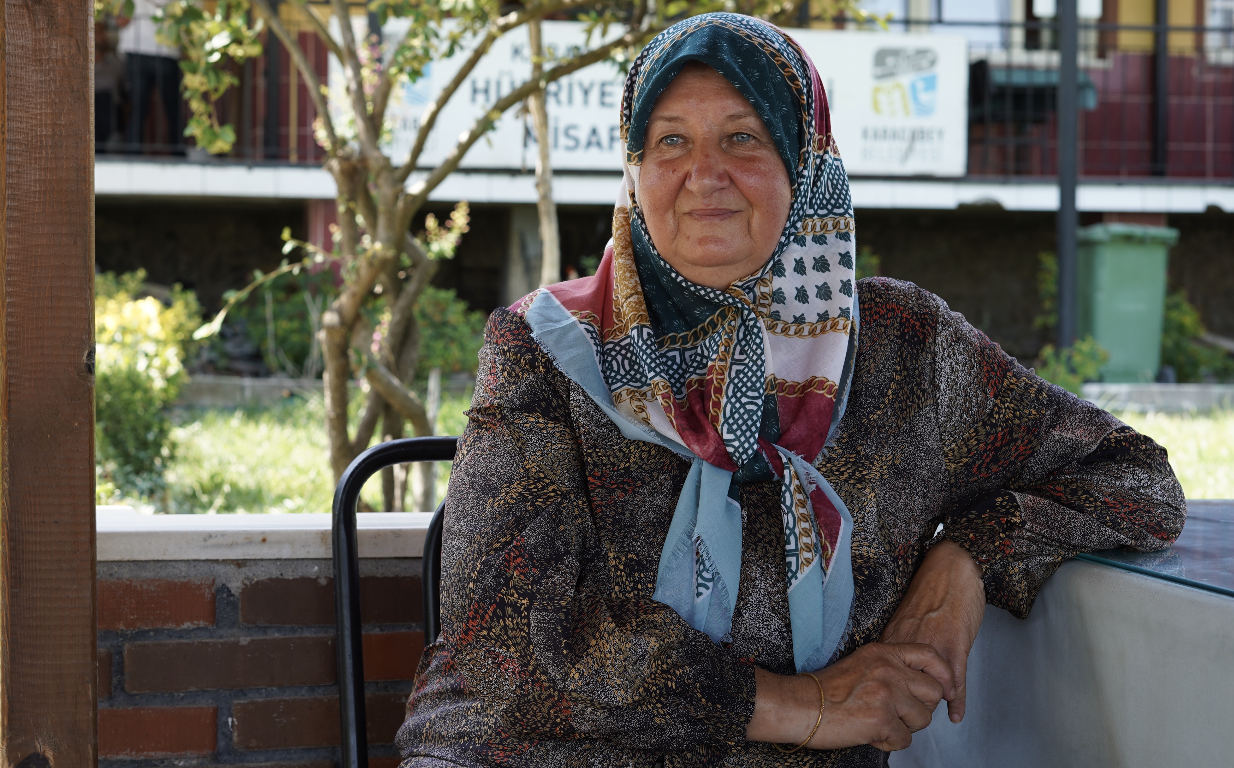
Nejla Özkılıç from Hürriyet
One of the Hürriyet village elders, Şakir Fikir, said, “As the village became more urbanised with these factories and industry, we lost our humanity too. We used to support one another. Now we don’t even give each other a sip of water.”
Teknosab promotes the industrial zone and surrounding projects as “modern, clean and peaceful satellite cities with large green fields.” But a peaceful life already existed in the area, one that is unlikely to ever return.


İbrahim Kılıç continues to sell milk to the city with the few animals he has left.
The meadows where animals once grazed are now occupied by Teknosab, forcing them to remain indoors all year round.
At the coffeehouse in Taşpınar, cattle farmer İbrahim Kılıç described the collapse of village life: “The arrival of industry ruined us. We used to have pastures and grazing land. Now, with less land, we’ve had to reduce our herds. They stay indoors all year.” His herd has dropped to just 15 cows, and he now has to buy feed because there is nowhere to graze. Milk production has collapsed, from six tonnes a day to just 600 kilos.
Mustafa Cingöz also reflected on the sense of hopelessness that has settled over those who remain in Taşpınar: “[Our young people] will become labourers. Security guards in factories. Working for minimum wage, for 22,000 liras (€450 a month) or whatever,” he said. “What do you expect me to feel? I’m angry. If I had the power, I’d remove them all today. But I can’t. What’s done is done. There’s nothing left to do.”
Teknosab did not answer our questions.
greentogrey.eu is an investigative data journalism project initiated by Arena for Journalism in Europe and the Norwegian Broadcasting Corporation, NRK. This is a cross-border collaboration between De Standaard (Belgium), Le Monde (France), Long Play (Finland), Die Zeit (Germany), Reporters United (Greece), Facta (Italy), NRK (Norway), Gazeta Wyborcza (Poland), Datadista (Spain), The Black Sea (Turkey), and The Guardian (UK).
Norwegian Institute for Nature Research (NINA) provided scientific expertise for the project.
Photos by Cemre Demircioğlu
Drone by Vedat Oruç
Additional reporting by Margarita Pshenichnaya
Satellite images are from Google Earth, with permission.
The Green to Grey project was produced with the support of Journalismfund Europe and IJ4EU.

