An hour and a half from Istanbul lies Sapanca, a place of natural beauty with rolling mountains of dark green forests cradling a pristine 10,000-year-old lake, favoured by concrete-afflicted Istanbulites as their closest oasis of nature. A place to breathe, to touch grass, to connect with nature.
But as night descends, the steady thump of basslines – “boom, boom, boom”– emanate from the hills as electronic music floats across the valley. In the past few years, Sapanca has shifted from a tranquil retreat to a playground, fuelled by a growing industry of “tiny houses” and bungalows that offer privacy and a party. Behind hastily constructed cabins with their plastic grass and heart-shaped pools, these new faces of Sapanca tourism are here to drink, take drugs, and get it on.
As one regular visitor from Istanbul put it, “We go to Sapanca to have sex in the jacuzzi, outdoor sex, that kind of thing. Because we like that. That idea appealed to us.” The town, she said, definitely has a reputation as a place of cheating partners and even sex tourism.
Another visitor, who has holidayed in Sapanca for years, said she has seen a change in its vibe as it became more notorious, a trendy hotspot. Now it is “more like a place for forbidden love,” a town for romance and extramarital affairs.
This small town’s embrace of tourism has led to a building frenzy, with the number of bungalows and tiny houses now exceeding 4000. Most went up in the last few years, without permits and often on protected land –a boomtown craze that has eroded biodiversity and cut off public access to much of the lakeside.
Our investigation reveals that the status of Sapanca’s lakeside was revised this year to accommodate business interests, allowing international hotel chains and even an AKP party member to maintain lakeside resorts on protected land.
Tourism has become so central to the economy of Sapanca that it has reshaped the town itself. When we visited in March, we found a town that resembled a construction site, marred by half-finished homes, torn-up roads, and a parade of heavy machinery spewing rock, debris, and dirt as they scurry across the town.
But the transformation is not only topographical. The rapid changes have brought other conflicts, including an increase in sex tourism. Sapanca is a town in flux, with locals divided between those cashing in on the boom and a smaller contingent dismayed at the municipality’s readiness to sacrifice precious land to unchecked development, with those who speak out risking harassment and violence.
Our report on Sapanca is part of Green to Grey, a cross-border investigation into the loss of nature and agricultural lands across Europe. More than 40 journalists from 11 media outlets –initiated by Arena for Journalism in Europe and the Norwegian Broadcasting Corporation, NRK– partnered with scientists from the Norwegian Institute for Nature Research. Using satellite imagery, artificial intelligence, and on-the-ground reporting, the Green to Grey project found widespread and accelerating loss of Europe’s nature, totalling 9,000 km² from 2018 to the end of 2023.
Turkey lost the largest area of any country by a significant margin, approximately 1860 km², an area comparable to the Asian side of Istanbul and more than ten times larger than Sapanca. Among the largest areas of construction are the Akkuyu Nuclear Power Plant, two coal-fired power plants, three gold mines, and Rize Airport. However, the most significant sites were overwhelmingly the dozens of Turkey’s organised industrial zones, highlighting the country’s courtship of business.
“We will go on talking about the scale of land destruction in ever-deepening terms,” said Eylem Tuncaelli, head of environmental policy and international relations at Turkey’s leading environmental protection NGO, Tema. “If you don’t follow science, if you don’t follow ethics, if you don’t prioritise the sustainability of life but instead prioritise the sustainability of development, then unfortunately these things happen. Not only in Turkey, but in any country that does this."
But while many stood out for their sheer size, Sapanca was remarkable for different reasons: a patchwork of small scars across the town and surrounding areas, signifying how its nature, once its greatest asset, is being chipped away piece by piece.
⌂⌂⌂
A THOUSAND CUTS
Sapanca was long known as a place Istanbulites would visit for weekend or day trips. They’d eat breakfast in the cafes along the lakeside, barbecue next to the tranquil Maşukiye stream, or walk through the many trails in the forests. Some families owned summer houses scattered throughout the town. The mountains, which stretch southwards and rise high above Sapanca, were largely untouched.
After the pandemic hit, people’s understanding of vacations and space began to shift. Those who had spent months confined to city apartments now craved crowdless retreats and green pastures. Landowners in Sapanca saw an opportunity.
“In Sapanca, many families, whom we could call locals, had owned plots of land for many years,” said Ali Safa Alaçam, the head of Savibu, an organisation of bungalow owners and lobbyists. “These had always just sat idle. Families decided to utilise their land and, in a modest way, built one or two units.”
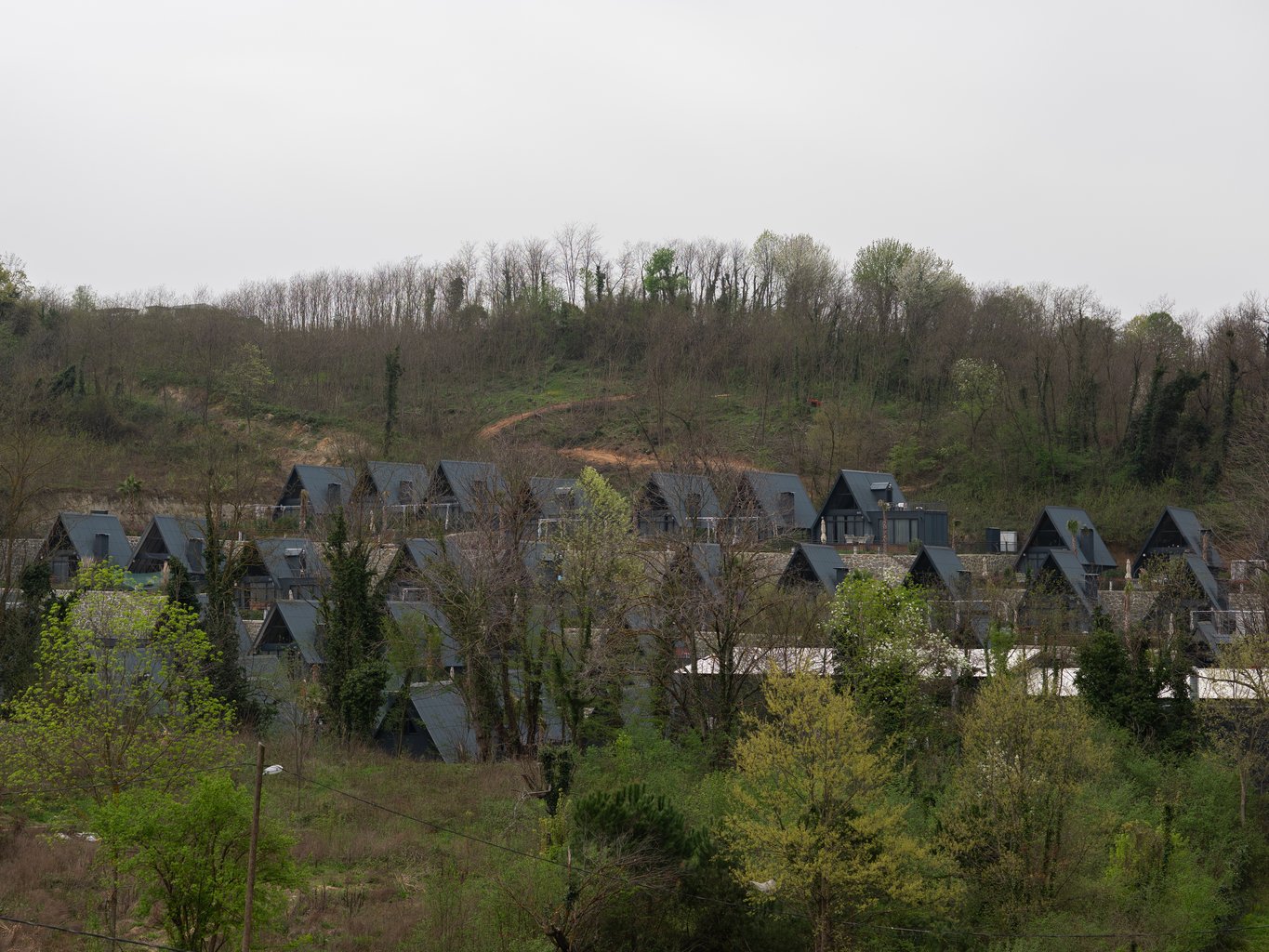
Tiny houses are cheap, quick to build, and generate good profits. The allure of fast cash became contagious. Soon, the bungalows began to creep further southwards, into forests and cropland. Trees were cut, and thousands of bungalows sprang up in their place, most of which were constructed without permits.
“There are no limits, and it's all done by locals,” Alaçam said. “It became a complete economic ecosystem. Everyone benefited. At a table of five people, one runs the bungalow, another does the cleaning, someone else supplies the fridge, their brother runs the breakfast business. We became a chain. That’s why the state turned a blind eye at first.”
Alaçam told us there are now 4,700 bungalows in Sapanca. The municipality provides a slightly different number. In December 2024, Sapanca Mayor Nihat Arda Şahin held a press conference where he revealed the results of an investigation into the extent of the bungalow trade in Sapanca. There were 4401 in total, he said. Only 400 were legal.
He did not explicitly propose to punish the owners or demolish the bungalows, but did announce that starting from the beginning of 2025, the 1500 businesses that held a “temporary tourism licence” would be redesignated as having “illegal status” as part of efforts to eliminate the irregularities in the town’s tourism sector.
“These structures contribute five billion Turkish Lira annually to the Sapanca economy,” he said. “Our goal is to bring these structures up to standard and regulate tourism. We don't want to suffocate a newborn," meaning to kill a burgeoning industry while in its infancy.
AKP city planner Oya Arapoğlu, a member of both the Sapanca Municipality and Sakarya Metropolitan Municipality councils, issued a statement criticising Şahin. “It is a fact known to all of us that some bungalow structures fall within protected sites, some within planned zones, and some in unplanned areas,” Arapoğlu said. She argued that the issue should be resolved through a “zoning plan” that would effectively legalise any unauthorised constructions, a common practice of dealing with illegal housing in Turkey.
“This is not a lawful practice," said environmental lawyer Esmanur Çağlak. "Sapanca has been under severe tourism-related destruction for many years. Public authorities do not exercise their power over the companies plundering our natural assets. As a result, we are faced with the bungalow invasion in Sapanca today.”
As Arapoğlu made her remarks, however, Turkey’s government and local officials had already begun to solve the problem in their own way, not through enforcing the laws, but by changing them to protect the so-called newborn.
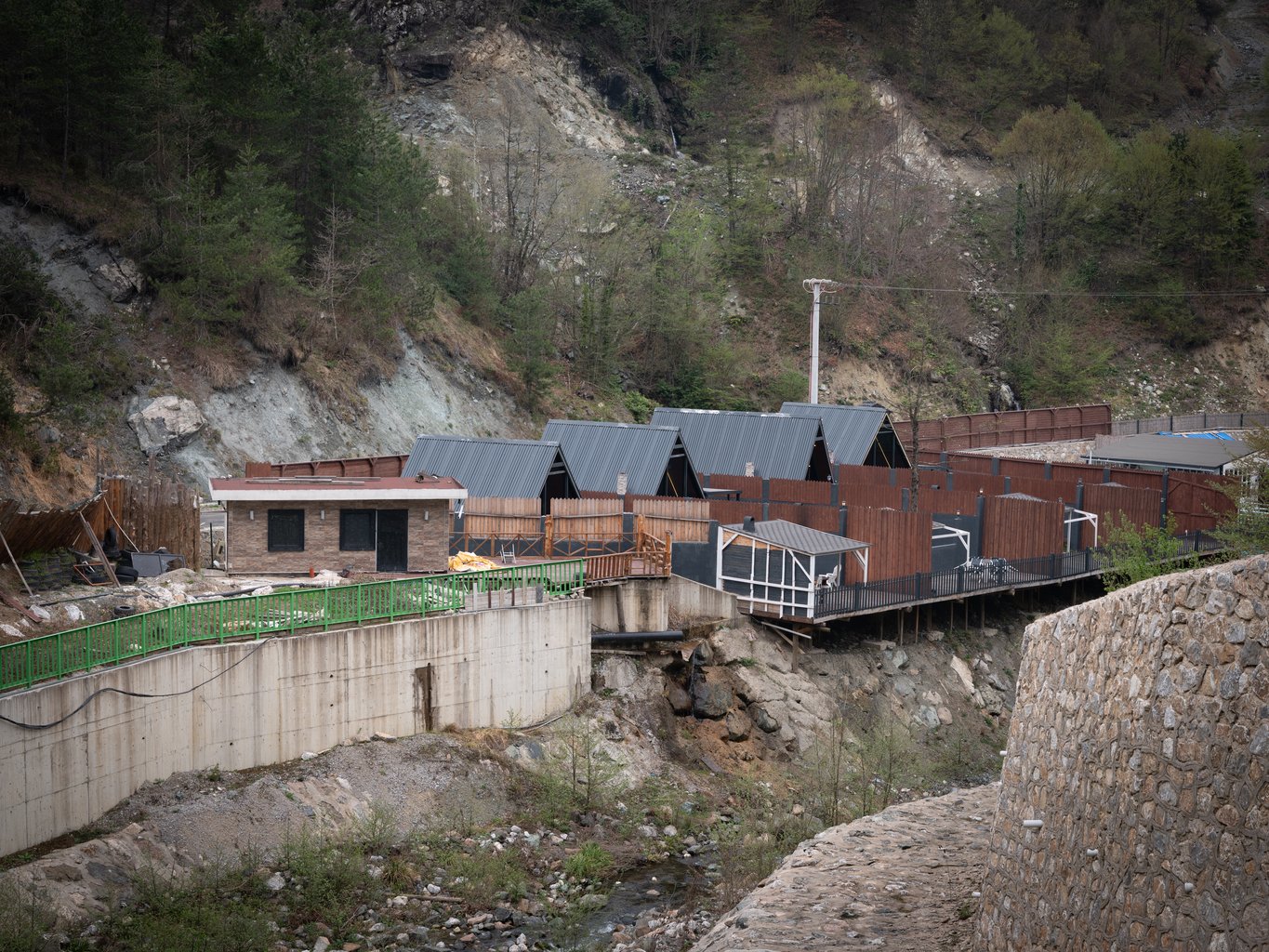
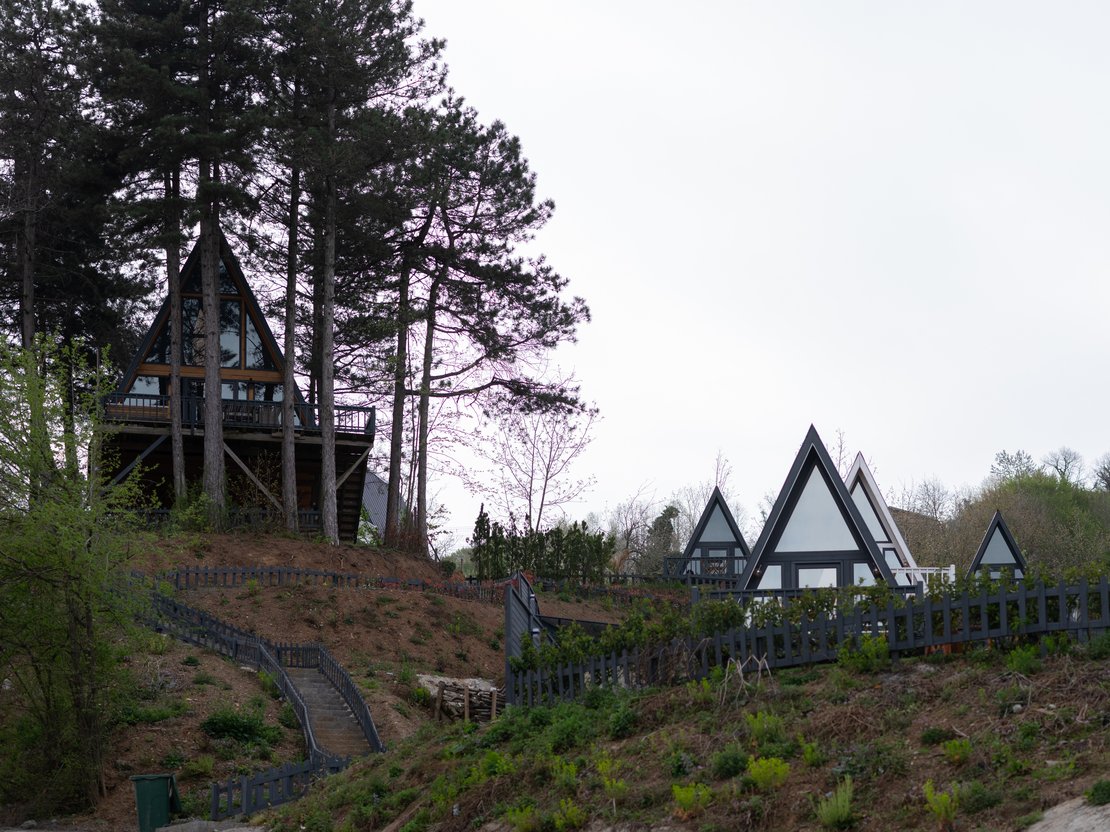
Bungalows built along the stream near İkramiye Village in the highlands of Sapanca.
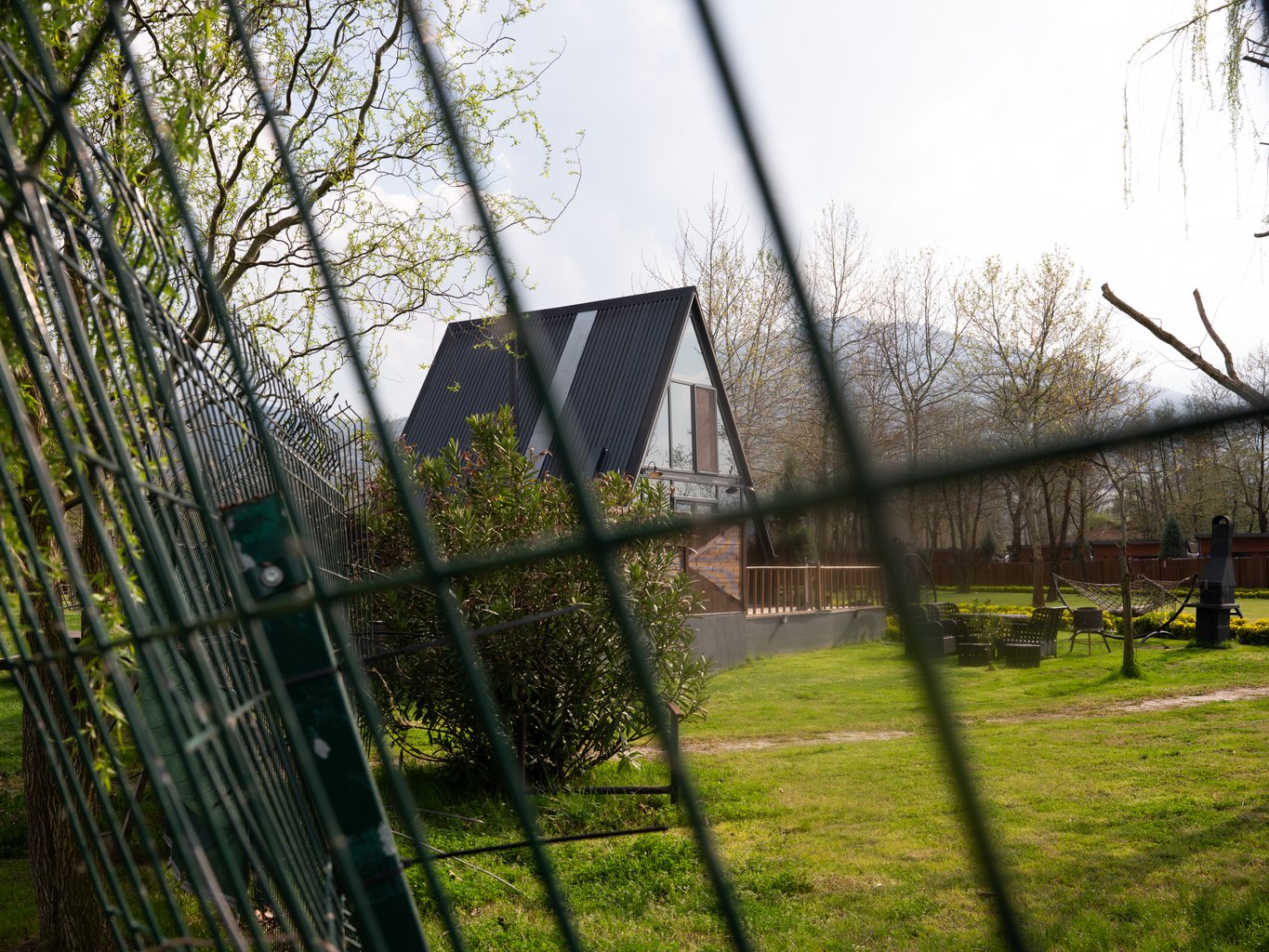
A lakeside business on the shore of Lake Sapanca, fenced off with wire, awaiting demolition.
“Wake to green, rest in blue”
What began as a few bungalows run by local families quickly attracted major hotel chains. “In the last two years, investors started to arrive,” said Alaçam. “Places with ten to fifteen units appeared. Then it grew to thirty, fifty, even up to ninety.” Today, Turkish groups like Dedeman and Elite World Hotels & Resorts sit alongside global brands such as Wyndham and Swiss luxury chain Kempinski.
One of the largest of these projects is NEF Sapanca, a $130 million partnership with Kempinski scheduled to open in 2026. It promises “200 hotel rooms and suites as well as the 50 villas and 138 townhouse apartments… surrounded by ponds, streams and lush woodland ribboned with walking, running and cycling trails.” NEF Sapanca is part of the NEF brand of Timur Real Estate Development, founded by prominent businessman and former Galatasaray vice-president Erdem Timur, whose fortune is estimated at $500 million.
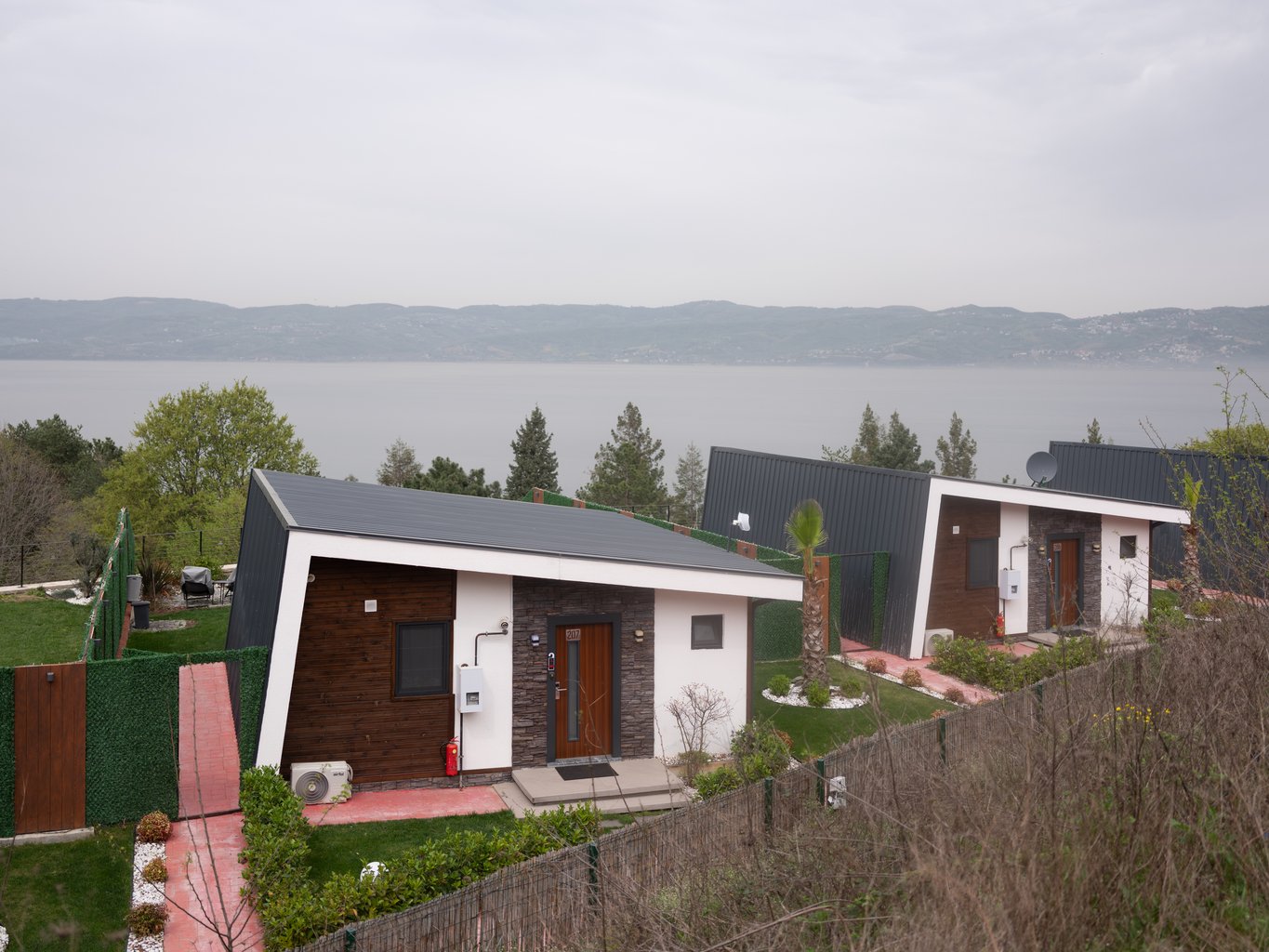
About ten kilometres east of NEF Sapanca lies Lake Look, a holiday retreat marketed with the slogan: “Wake to green, rest in blue” in the “very heart of nature.” Lake Look’s owner, Eren Group, has ties to the ruling AKP. In 2021, the year construction began, CEO Ali Ethem Yıldırım was serving as chief advisor to Sakarya’s AKP mayor Ekrem Yüce. Yıldırım’s son and the CEO of Lake Look, Selim Yıldırım, was elected to the AKP’s local committee in Sakarya that same year.
The projects broke ground in 2021. Both did so on lakeside locations that were officially classified as first-grade protected land, the highest classification possible, specifically due to their importance for natural heritage and the town’s source of drinking water. The development of housing, tourism, industrial, or commercial buildings on first-grade land should be strictly prohibited. These examples are far from isolated cases. The town is littered with bungalows and tiny houses, and hotels all along its shore.
To address the problem of hundreds of illegal tourism businesses on protected land, in January 2025, the Ministry of Environment and Urbanisation simply revised Sapanca’s conservation map.
Much of the lakeside, once afforded the highest protected status, has since been downgraded to a Qualified Natural Conservation Area, effectively the second tier, just below Absolutely Protected Sensitive Areas. In theory, land with this designation cannot be built upon except in rare cases, and even then only under strict conditions.
But the map tells a different story. Several strips of land along the shore were reclassified even further, to the lowest level of protection, as Sustainable Conservation and Controlled Use Areas. Within this patchwork, two developments stand out: Lake Look and NEF-Kempinski, which were singled out as isolated “islands” of third-degree conservation zones –a reclassification that resolved their legal status.
Further east is Lake Look’s neighbour, Ramada Resort, owned by US-based Wyndham Hotels & Resorts, one of the world’s largest hotel groups. It operates over 90 bungalows, which were built without proper licences. Local news reports that the resort has faced licensing issues. SASKİ, the water utility under Sakarya Metropolitan Municipality, even cut off the water supply in 2024 over irregular use. In May of this year, Zabita closed Wyndham’s ninety-one bungalows at the Ramada Resort by Wyndham Thermal Sapanca due to the lack of proper licences. Part of its boundaries, however, appear to fall into the new protected zone.
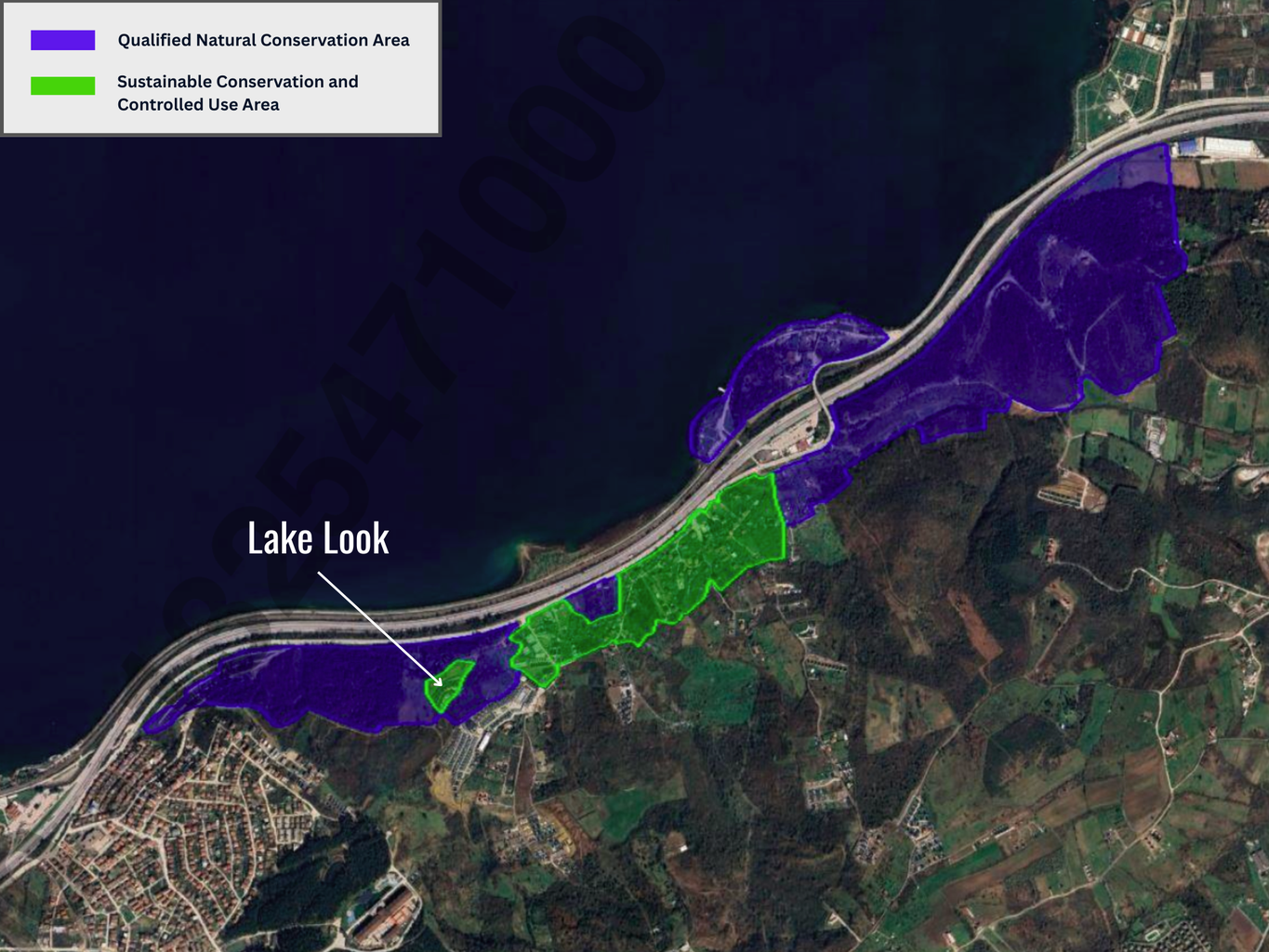
Sapanca’s new conservation map.
Lake Look
BYE BYE BIRDY
It is unclear from public records whether all the lakeside land to the west, where numerous bungalows are located, was also affected by the zoning changes. The maps are not available in the official registries.
By law, however, the first 300 metres around any part of Lake Sapanca should fall within the Absolute Protection Zone due to its vital role in providing the town with drinking water. All structures on the shoreline, of which there are many, are technically prohibited.
It is not only the public’s right to water that is at risk. The bungalows have also pushed into habitats of birds that made Sapanca the ecological treasure that attracted tourists in the first place. A 2010 study identified 69 bird species, including the Ferruginous duck, classified as ‘near threatened’, and the officially ‘endangered’ White-headed duck.
By 2023, researchers Dilek Temur and Ali Uzun of Sakarya University were seeing a decline. “Tourism and day-trip activities are particularly heavy between March and July, which coincides with the breeding season of birds, directly affecting breeding success in a negative way,” they wrote. The narrowing — and in some places “complete destruction” — of reed beds at the lake’s eastern and western ends were impacting breeding grounds. “With its location and habitat characteristics, Lake Sapanca is an important wetland for birds in both the region and Turkey,” the study concluded. “Lake Sapanca must be included in the list of Wetlands of International Importance. Furthermore, prohibiting the use of lake water for industrial purposes is another urgent step that must be taken.”
“Every day we lose more of our biodiversity,” said Eylem Tuncaelli, from Tema. “We are losing our wetlands. Data shows us that we cannot protect our forests or our water resources. They are being sacrificed to mining, transportation, renewable energy transmission lines, and similar things. We are sadly witnessing their decrease day by day.”
The subject of their demolition frequently surfaces in Sapanca’s public agenda, yet little action is taken. In April 2023, for instance, the Sakarya Water and Sewerage Administration (SASKİ) applied for the demolition of 125 bungalows built along the lake’s edge, a move that was approved by the tourism and interior ministries. Two years on, the bungalows remain standing.
Other bungalows that fell within the old protected zones also remain operational. In March 2024, a few locals filed a complaint with the municipality over a new construction on the shores of the lake. Residents said that while the municipal inspection team followed up on the complaint, they failed to take any action.
“While we, the local residents and nature-loving environmentalists, ask ‘how is it right to build these structures’” they asked, “the authorities who are supposed to protect these areas do not question them at all, choosing instead to ignore them for political gain and profit.”
The bungalows continue to operate.
Sapanca municipality told us, in response to a Freedom of Information Request, that "regarding the bungalows and similar structures built within the boundaries of our district, inspectors were assigned by the Ministry of Interior to carry out an investigation. A criminal complaint has been filed against those responsible. The procedures concerning the properties are still ongoing."
They did not elaborate.
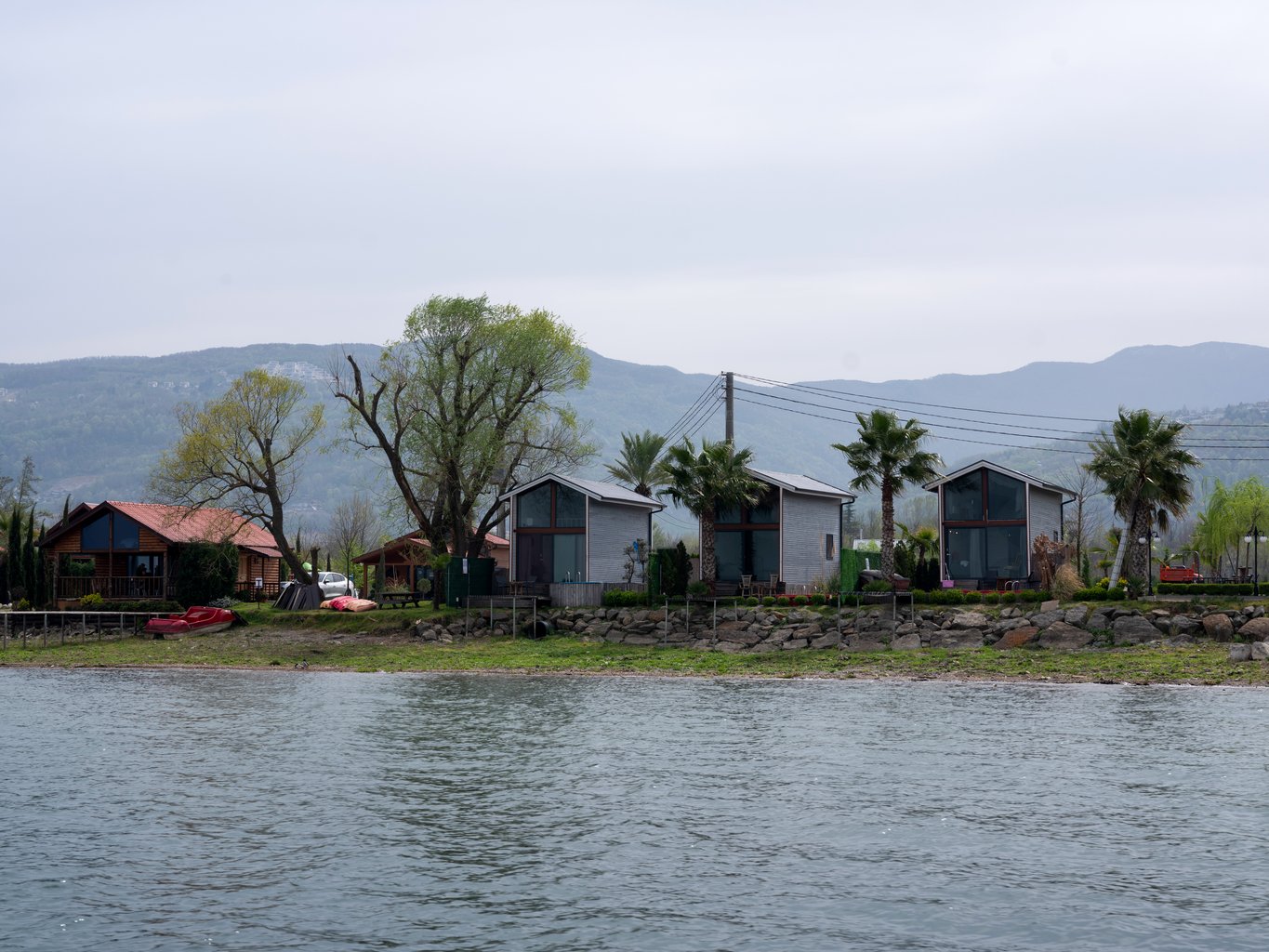
Another bungalow business on the shore of Lake Sapanca.
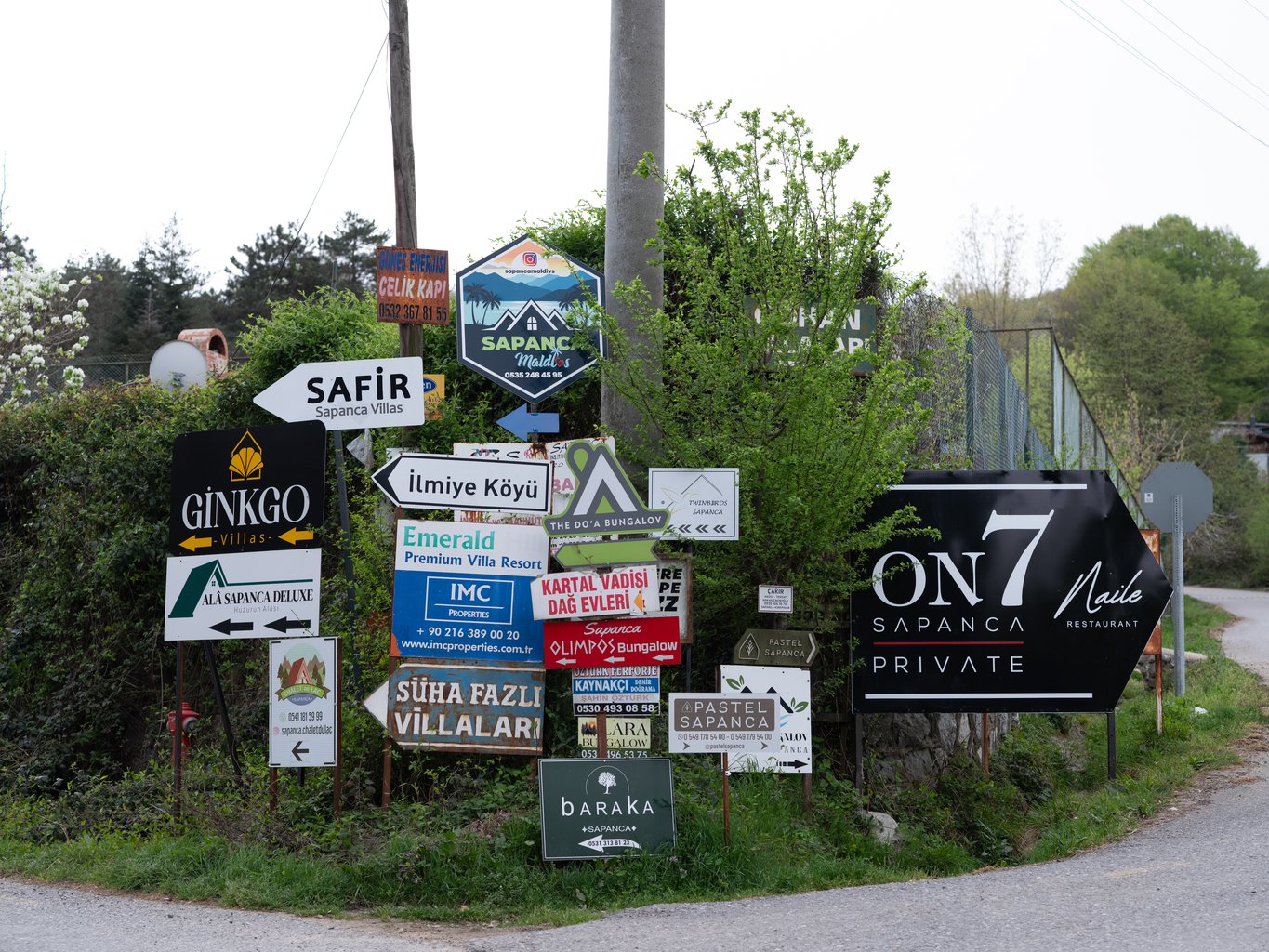
Roadside signs advertising bungalows in every corner of Sapanca.
⌂⌂⌂
What was once a back-and-forth over zoning has recently become increasingly politicised — and in a fashion familiar to Turkish politics.
In March, Sakarya’s AKP governor, Rahmi Doğan, said following a series of meetings with Sapanca’s CHP mayor, Nihat Arda Şahin. “I made it clear that we will never allow any encroachment on public property, on our shared values, or on stream beds, especially along the shoreline of Lake Sapanca,”
Doğan announced that 369 bungalows built on riverbanks within Sapanca’s mountains would be demolished. "An inspection carried out by the Ministry of Interior determined that these bungalows were built inside the stream bed. Our work also continues for those located in absolute protection zones," he said. Again, they remain standing.
He added that he was considering an investigation into the granting of permits and the construction of illegal buildings. A week later, the Ministry of Interior gave the go-ahead to launch an investigation into Şahin, who was elected only in 2024, and his deputy, Burak Koç. Also included in the probe were former AKP mayors Özcan Özen and Aydın Yılmazer, who oversaw much of the bungalow boom.
Şahin claimed that the motivation behind the investigation was political, noting that the decision had been made in December but was only communicated to them four months later, after a series of scandals in Turkey’s tourism industry. “In these days when we are going through a test of democracy and justice, it is striking that the decision was withheld for three months,” he said publicly. This was because the process coincided with the early days of the government’s attacks on the CHP, which began with the arrest of the Mayor of Istanbul, Ekrem İmamoğlu.
THE UN-RESISTANCE
Tourism in Sapanca is now a big driver in the local economy. Some accommodations are now more expensive than a stay at an Italian castle, according to one news outlet. The boom not only impacts the bungalows, but also restaurants and boat tours. Even delivery drivers are experiencing the good times. At least according to Alaçam. “These are 18 to 23-year-old locals who bought scooters and got licences to offer delivery services,” he said. “Guests can now call and ask for groceries, meat, produce. The couriers go to three or four stores and deliver everything while guests relax by the pool.
Don’t know how to start a barbecue? “Someone will come and help,” he said. “You call, and someone comes to cook your food, prepare your salad, light the barbecue.”
But it was no act of generosity. The regular visitor who’d been to Sapanca since she was a child told us that grocery prices have soared, and everything now comes with a cost. After she asked one proprietor for a lighter to start a barbecue, “the guy said, ‘I’ll light it for you.’ We thought it was like room service. He came with a little torch, lit it, and charged 500 Turkish Lira just for that. We were shocked.”
With so much on the line, it is understandable that barely a handful of the town’s residents dare to publicly oppose the bungalows or complain of their impact on Sapanca’s nature. Even less so, the cultural changes of the last few years. When we met with a small-business owner who has been living in Sapanca for many years, she told us that she received threatening messages and phone calls after posting about bungalows on social media. Some of the locals, she said, “prefer communicating by shouting and by violence.”
Among the issues she raised was the increase in sexism and sex tourism in the area. Even a cursory search of “tiny houses” or “Sapanca bungalows” on social media returns dozens of posts of women advertising sex for sale, and often accompanied by photos of Sapanca’s tiny houses with their heart-shaped pools and rose-petal adorned beds.
While not a phenomenon unique to Sapanca, it is a strange kind of compromise for a traditionally conservative town. The business owner, while a supporter of women’s rights and protections for sex workers, expressed concern at a shift she was witnessing, especially towards women.
“I experienced the change in [the kind of] people walking on the street,” she said. “Strange kinds of men started to use the common spaces. They look at all the women as, I don't know, a potential, a commodity.”
She sees couples who are not couples, and more than once saw men threaten women in public. The bungalows, she says, give these men freedom to behave with an impunity that a hotel cannot offer. “In the bungalows, they can live out all their darknesses. It's a kind of free space for their fantasies.”
⌂⌂⌂
The popularity also brought other problems. In March this year, a group of twenty-two people were arrested for scamming thousands of people out of 120 million TL through fake bungalow ads on social media.
The following month, a family staying at one of the bungalows discovered a hidden camera inside a light fixture that was recording from above the beds. During the investigation, police found a photo of the hidden camera on the owner’s phone. He and a friend were arrested on charges of “violating the privacy of private life,” and have been released pending trial.
Local news published footage in August of the bungalow owners fighting with the family that reported the hidden camera ahead of a court hearing.
Sapanca'da ampul içinde kamera bulunan bungalov otelin sahipleri ve müşteriler arasında duruşma öncesi kavga çıktı. pic.twitter.com/TGss8IJosA
— Haber Taksim (@habertaksimcom) August 6, 2025
The lack of oversight of the bungalows has fatal consequences. In February 2023, a young couple lost their lives in a fire at one establishment while vacationing there for the weekend. There have been many other fire incidents since then, but none fatal.
In May, a four-year-old child who was on vacation with his family at a bungalow facility called Garden Home fell into a pool and died. The subsequent investigation revealed that the facility’s temporary operating licence had been revoked months earlier, and that the staff had entered the customers’ details into the mandatory registration system only after the child’s death. The facility remains on SAVİBU's website, despite a lack of an operating licence.
None of this seems to be deterring tourists. Alaçam said that the bungalows are occupied almost all of the time. This past summer, Turkey’s Anadolu Agency reported that the town was at full capacity during Eid, with the number of visitors surpassing that of residents.
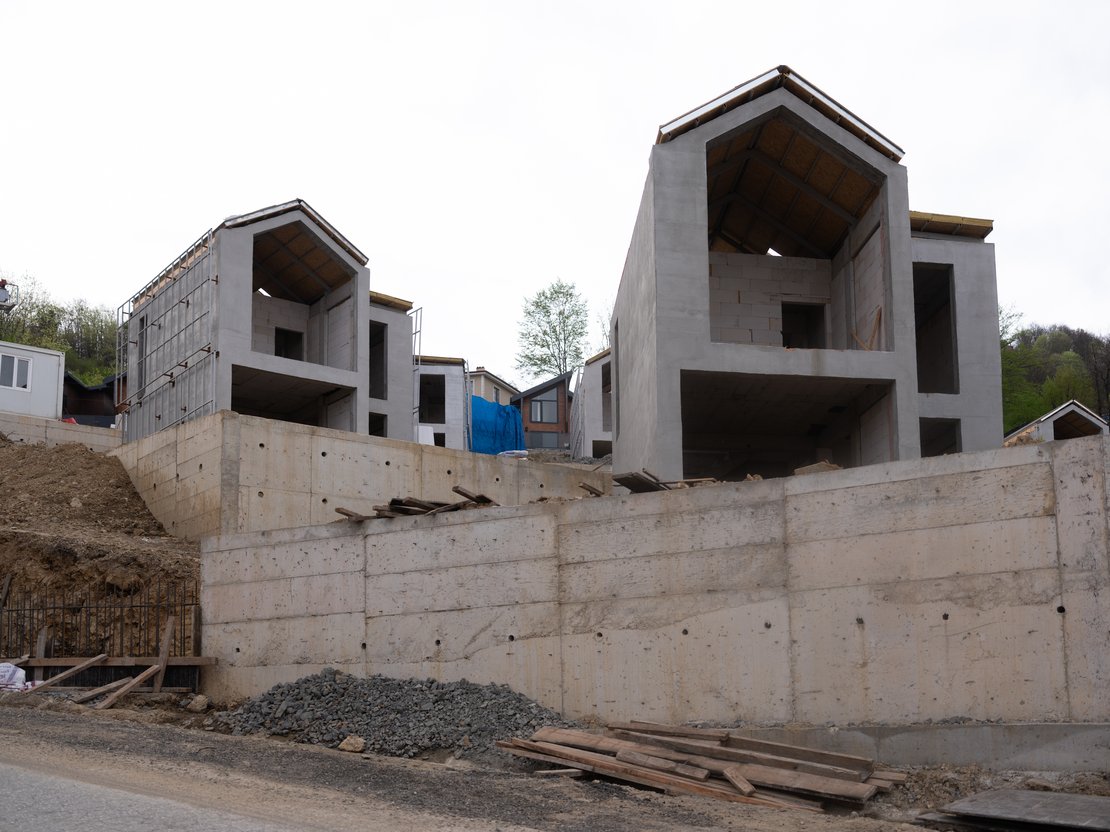
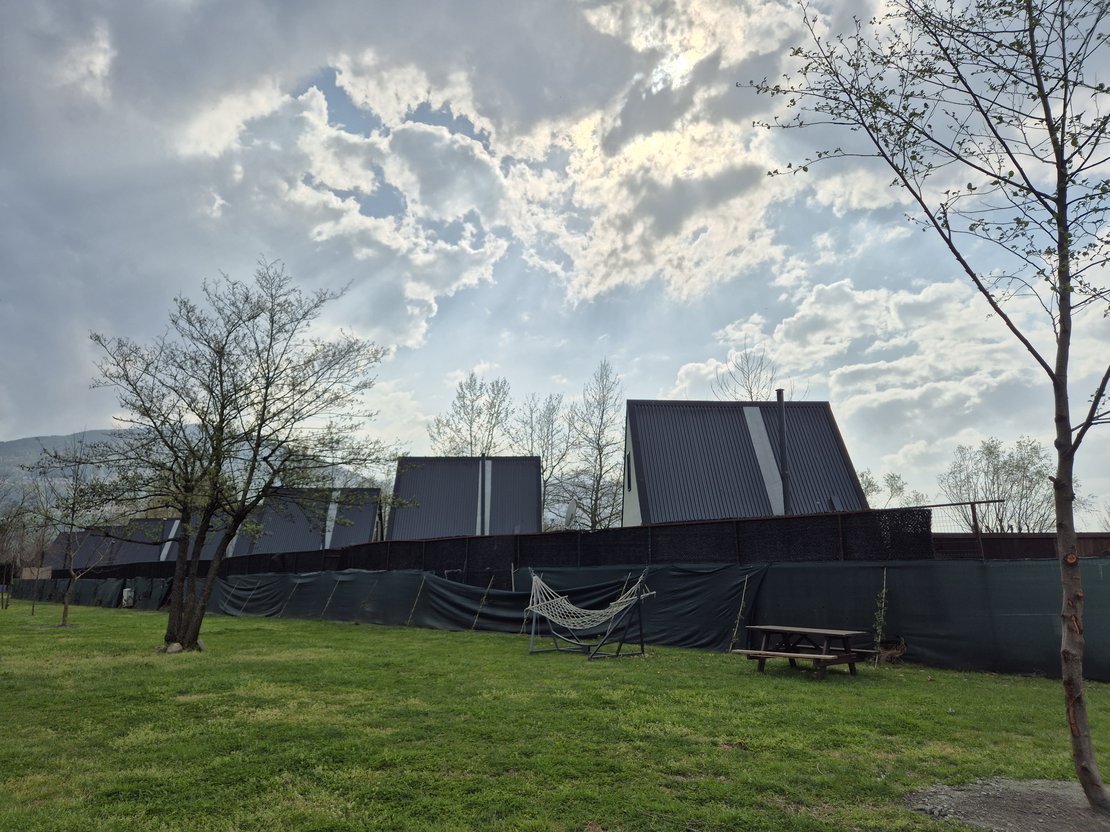
Construction sites in the hills of Sapanca.
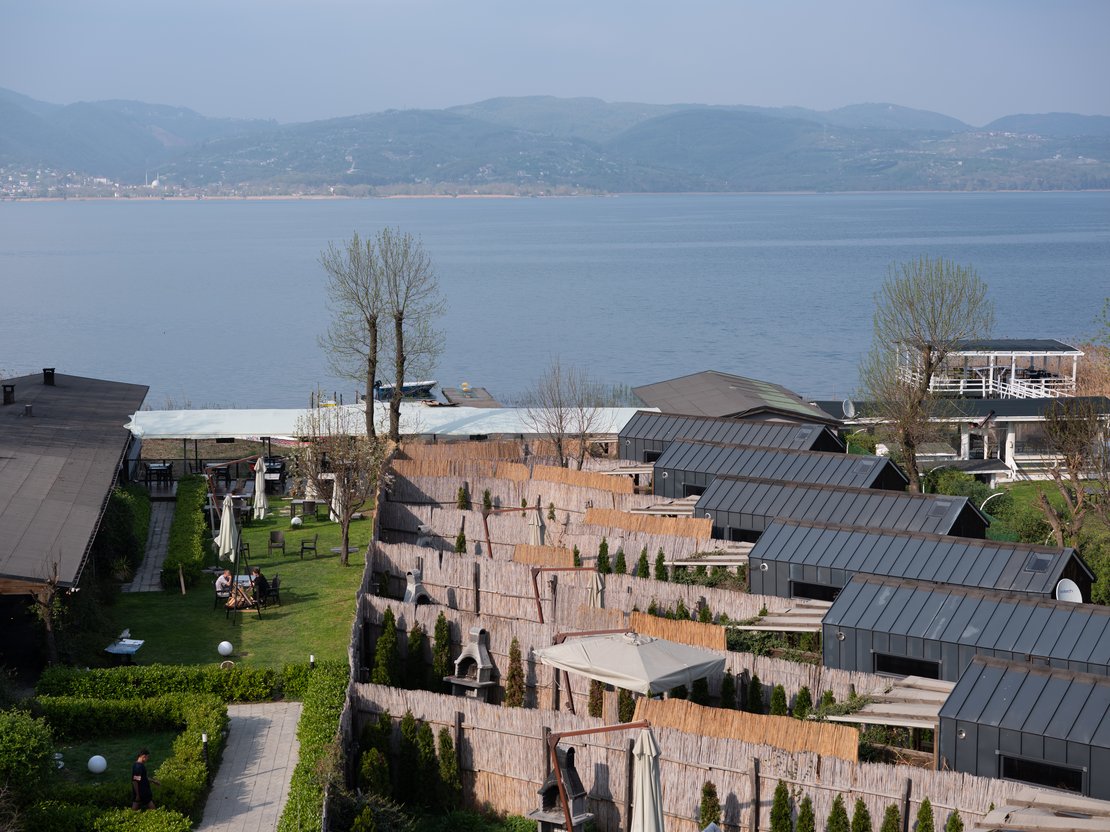
Rows of bungalows crowd the lake shore, cutting off public access.
greentogrey.eu is an investigative data journalism project initiated by Arena for Journalism in Europe and the Norwegian Broadcasting Corporation, NRK. This is a cross-border collaboration between De Standaard (Belgium), Le Monde (France), Long Play (Finland), Die Zeit (Germany), Reporters United (Greece), Facta (Italy), NRK (Norway), Gazeta Wyborcza (Poland), Datadista (Spain), The Black Sea (Turkey), and The Guardian (UK).
Norwegian Institute for Nature Research (NINA) provided scientific expertise for the project.
Photos by Özge Sebzeci
The Green to Grey project was produced with the support of Journalismfund Europe and IJ4EU.