“It used to be all red here,” said 66-year-old Gursel Cakir, remembering the flamingos that once flocked to the Çaltılıdere wetland in İzmir. “There would be hundreds of them. They’d fly so colourfully. When the construction started, it all ended.”
What was once a pit stop for dozens of species of migratory birds and a spawning ground for fish is now a barren stretch of concrete that has pushed the sea more than a kilometre away from the shore. By the end of this year, the former Çaltılıdere wetland will be a concrete and steel facility for building and repairing luxury yachts.
Six hundred and forty-six kilometres away on the Black Sea coast is where the Filyos delta had stood. It, too, has now been destroyed. Once home to hundreds of animal species, many of them rare, the delta is now claimed by the state and turned into an industrial hub for gas storage.
Çaltılıdere and Filyos are just two examples of the increasingly widespread destruction of vibrant ecosystems in Turkey's quest for economic growth. Despite the scientific consensus on the importance of wetlands as natural defences against extreme events, such as flooding and erosion, developers and the government dismiss them as mere "swamps" or "wastelands." In doing so, they sacrifice ecologically vital habitats to the promise of jobs and financial benefits for local communities.
The Black Sea investigated these two wetlands as part of the Green to Grey cross-border journalism project that aims to quantify the loss of nature to construction in 30 European countries, including Turkey. In collaboration with the Norwegian Institute for Nature Research, a team of 11 European newsrooms developed a novel methodology that combines AI and satellite imagery to detect areas where natural land has been lost to construction, a process known as artificialisation.
Our findings show that Turkey tops the list with the largest portion of natural areas of any country, with an estimated 1,860 square kilometres destroyed during the six-year period between 2018 and 2023 (read more about the project here), equivalent to the size of 280,000 football pitches. Much of the destruction picked up by the AI model has been ‘mega’ state projects, industrial zones, and mines.
“Every time I think about it, my heart aches”
In April 2017, the local wetland commission had already ruled to preserve Çaltılıdere’s protected status, basing its decision on an expert report from Dokuz Eylul University that confirmed the area’s wetland characteristics. The decision should have put an end to plans by the industry cooperative, YATEK, to construct a yacht-building facility on the Çaltılıdere wetland.
It didn’t. On 26 October 2017, six months after the ruling, the matter was forced back onto the agenda, now accompanied by a new “public interest” justification. Sixteen commission members gathered in a room to debate the issue. This time, however, the pressure to approve was different –more prominent. Loyalties and votes began to shift away from protecting the area. By the end of the meeting, the balance had tipped against Çaltılıdere, and the majority voted in favour of YATEK’s plans. It signalled the beginning of the end of the Çaltılıdere wetland.
“I was there to defend the wetland,” one of the commission members told us. He described a tense and combative meeting that ended with a sense of betrayal when the governor’s office broke the tie with the deciding vote. Çaltılıdere, in the eyes of the Turkish state, was no longer a wetland. “We couldn’t save it this time,” another commission member told him afterwards. “This country is not a place where people like you get what they want.”
Six months before the fateful commission meeting, the president of YATEK, Aslan Bilgi, made their intentions clear in an interview with an industry magazine: “The previously given [affirmative] wetlands decision regarding this region is causing us to lose some time. We are working to get an opinion from Dokuz Eylül University. If we do not get the result we want, we will get an opinion from Ege University.”
Shopping around for expert opinions worked. During the subsequent commission gathering, the governor’s office presented the new report from Ege University that claimed Çaltılıdere had “lost its ability to be a habitat for many species.” YATEK rallied around this report, and the governor’s office used it as the primary justification for its final decision.
“In the end, they manipulated the process,” said the commission member, “and got the wetland status revoked.” Unlike the other commission members, he knew Çaltılıdere personally. He visited the place often for birdwatching. “I still think about this place from time to time. And every time I think about it, my heart aches,” he said. “I don’t want to see what it has become.”
Video: Yatek
Today, the scene in Çaltılıdere is stark. Standing on what was once the edge of the wetland, the view is of a concrete desert stretching to the horizon. There are no longer any fish, no birds. Just a flatland of cement and a single baby sea turtle trapped in one of YATEK’s artificial wastewater canals. This was a vibrant ecosystem: pelicans, flamingos, ducks, and pygmy cormorants fed and mingled in waters where sea bream and sea bass lived year-round. “I could see the fish eggs with my naked eye,” said Gursel Cakir, a local. “There were so many”.
Wetlands are crucial habitats for countless species and are increasingly under pressure from urban expansion and climate change. According to a 2025 report from the Convention on Wetlands, the Mediterranean region has lost 20% of its wetlands in the last 30 years. But wetlands and peatlands aren’t only for birds and fish. They serve as vital carbon stores and natural flood protection. “Wetlands act like natural sponges, retaining excess water during rainy periods and gradually releasing it during dry periods, mitigating the effects of both floods and droughts,” said Burçin Yaraşlı, a wetlands specialist with Doğa Derneği, an environmental association in Izmir. “When these areas are destroyed, people living nearby face greater risks.”
Flipping a wetland into a flat, cemented area erases the normal buffer capacity that wetlands offer, as they can no longer absorb rainwater. “Wetlands are wet for a reason. This is how nature intended water to float through the landscape,” explained Anders Lyngstad, a peatland expert at the Norwegian Institute for Nature Research. “When you tamper with that, the water ends up in places where it wouldn’t naturally go.” This leaves nearby towns and cities open to the risk of flooding.
YATEK claims that the yacht shipyard will bring massive economic growth and thousands of jobs to the area. The company is hopeful that it can commence manufacturing as soon as possible and anticipates yacht exports to reach €500 million annually. “The richest people in Turkey and in the world will bring their big yachts here and repair them or have them built,” the former YATEK director said in an interview in 2021. YATEK foresees manufacturing up to 132 luxury yachts every year.
YATEK told us, “this investment is fully compliant with environmental regulations, respectful of nature and ecosystems, socially responsible, and economically beneficial for the region and the country as a whole.”
Rich biodiversity vs natural pride
The Filyos delta on the Black Sea coast suffered the same fate as Çaltılıdere. A large wetland home to more than 300 species of birds, Filyos is central to the Turkish government’s “Filyos Valley Project,” which involves eliminating the delta to make way for a natural gas storage facility and mega-port. The playbook is similar: to prioritise industrial growth over nature, the state sidelines scientists and local opposition and then begins construction as fast as possible.
When offshore natural gas reserves were discovered in the Black Sea in 2020, President Erdogan announced that it was “the biggest gas discovery in Turkey’s history.” The government promised Turks that the reserves would satisfy 30% of Turkey’s gas demand. “We thank our God for showing us and our nation these days,” the president said in his announcement. The Filyos delta was the closest land to the exploration ships. A year later, he signed a presidential decree ordering the expropriation of 50 hectares of land belonging to the villagers and handed it over to BOTAȘ, the state-owned petroleum and gas company. A few months later, BOTAȘ sent bulldozers to Filyos, uprooting the fruit trees and flattening the farmland.
The government then allocated additional areas in the valley, including almost 600 hectares for an industrial zone. In a speech in 2021, President Erdoğan promoted the Filyos project as “Turkey’s first mega industrial park,” one that would “bring investors to the area” and “contribute greatly to the production, exports, and employment in Turkey.” He added, “I am excited.”
In addition to the gas processing and storage facility, the construction project now includes a large port, an industrial zone, and an additional 620 hectares of “free zone” where the industry can expand.
The Filyos delta was home to around 30 of the 40 rare bird species found in Turkey, including the endangered long-tailed duck, spotted eagle, and Dalmatian pelican, which fascinated birdwatchers with its huge body and scruffy appearance.
Former studies confirmed it was “extremely rich” in biodiversity and a “rich habitat not only for birds but also for many other species.” The first sighting of a rough-legged hawk and a desert warbler in Turkey was in Filyos. Farmers grew strawberries, corn, and beetroot on the fertile alluvial soil.
“The Filyos Delta has a huge importance as a wetland. Agricultural land is very limited in the Black Sea region, which makes the farmland in that area especially valuable,” explained Esra Yazici Gokmen, an urban planner and environmental policy officer at TEMA Foundation, a leading environmental NGO in Turkey. “It is a place that should be guarded as our most precious possession.”
Video: TPAO
The struggle to protect Filyos goes back to the early 2000s, when the state designated the valley suitable for industrial expansion. The TEMA Foundation sued the government in 2010 and again in 2012. At first, they were successful. Expert reports confirmed their arguments, and the courts annulled construction orders. In 2015, the Ministry of Science, Industry and Technology’s own feasibility report suggested that the Filyos delta was “ecologically sensitive” and that due to the forest area and the wetland stretching through the valley, “it does not seem possible to create large parcels for the industry.”
But each time a case was won, the project would soon reappear. The last court case, the fifth TEMA has filed in the matter, resulted in the court rejecting their arguments. “Despite the scientific and legal evidence demonstrating that the Filyos Valley is unsuitable for industrial development, all court rulings have been disregarded,” Esra Yazici Gokmen said. “Industry has been developed at the expense of irreversibly disrupting the valley's ecological balance.”
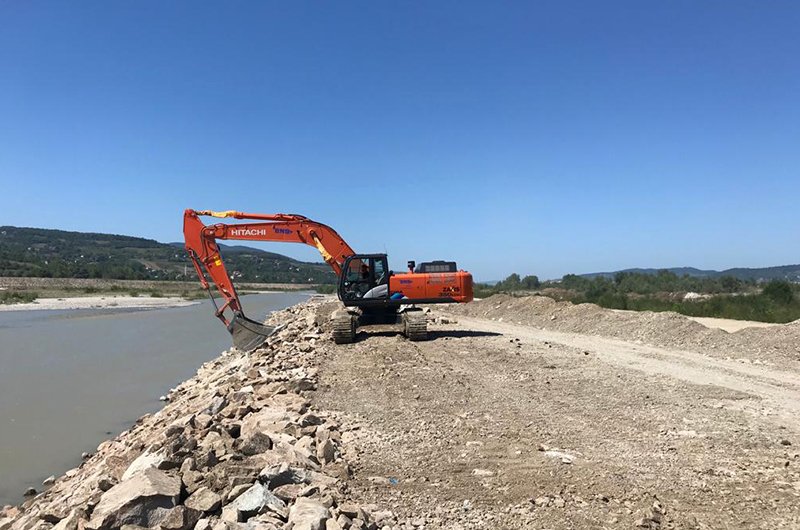
Experts we consulted expressed surprise that such a large delta was chosen for development, especially for a natural gas facility. “It is quite a risky thing to build critical infrastructure in such areas,” said Anders Lyngstad. “This is where the floods will come. This is where the water will end up.” As part of the Filyos Project, the government initiated a multi-year plan to build concrete floodwalls and barriers to contain the river flowing through the delta. The environmental impact assessment for the project mentions that the river’s water mass can reach up to 20 times its normal rate. According to Lyngstad, floodwalls are important protections that can be effective if built properly. But he warns: “You can’t always build yourself out of harm’s way. You can do a lot, but there is a small risk that you can’t contain it. And when it fails, it probably will fail spectacularly.”
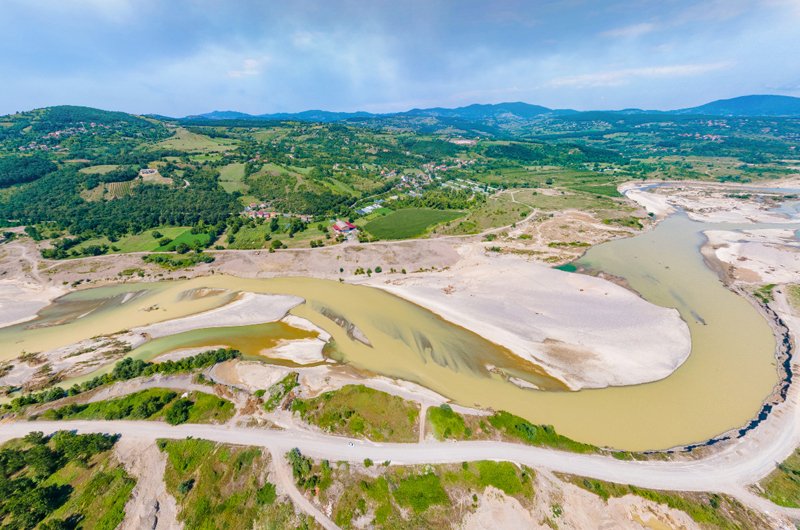
How the Filyos river naturally flowed before construction. Photo: BNB Insaat.
Floodwalls being built to contain its water mass which can reach up to 20 times its normal rate. Photo: BNB Insaat.
Filyos and Çaltılıdere provide good examples of Turkey’s approach and model of development and economy, where construction has been central to the economy for more than two decades, since Erdogan came to power. Two wetlands, on two different coasts, both recognised for their ecological value hastily sacrificed for cash and votes. For scientists and experts, they are examples of short-term growth coming at the cost of long-term resilience against the effects of extreme weather events caused by climate change.
“The migration routes of hundreds of thousands of birds living in a delta or the survival of fish populations often remain invisible among everyday concerns. But from a scientific perspective, wetlands are unique ecosystems essential both for biodiversity and for the continuity of human life,” said Burçin Yaraşlı. “Destroying them essentially destroys our own future.”
Banner video: Flamingos in Izmir / Doğa Derneği
greentogrey.eu is an investigative data journalism project initiated by Arena for Journalism in Europe and the Norwegian Broadcasting Corporation, NRK. This is a cross-border collaboration between De Standard (Belgium), Le Monde (France), Long Play (Finland), Die Zeit (Germany), Reporters United (Greece), Facta (Italy), NRK (Norway), Gazeta Wyborcza (Poland), Datadista (Spain), The Black Sea (Turkey), and The Guardian (UK).
Norwegian Institute for Nature Research (NINA) provided scientific expertise for the project.
The Green to Grey project was produced with the support of Journalismfund Europe and IJ4EU.